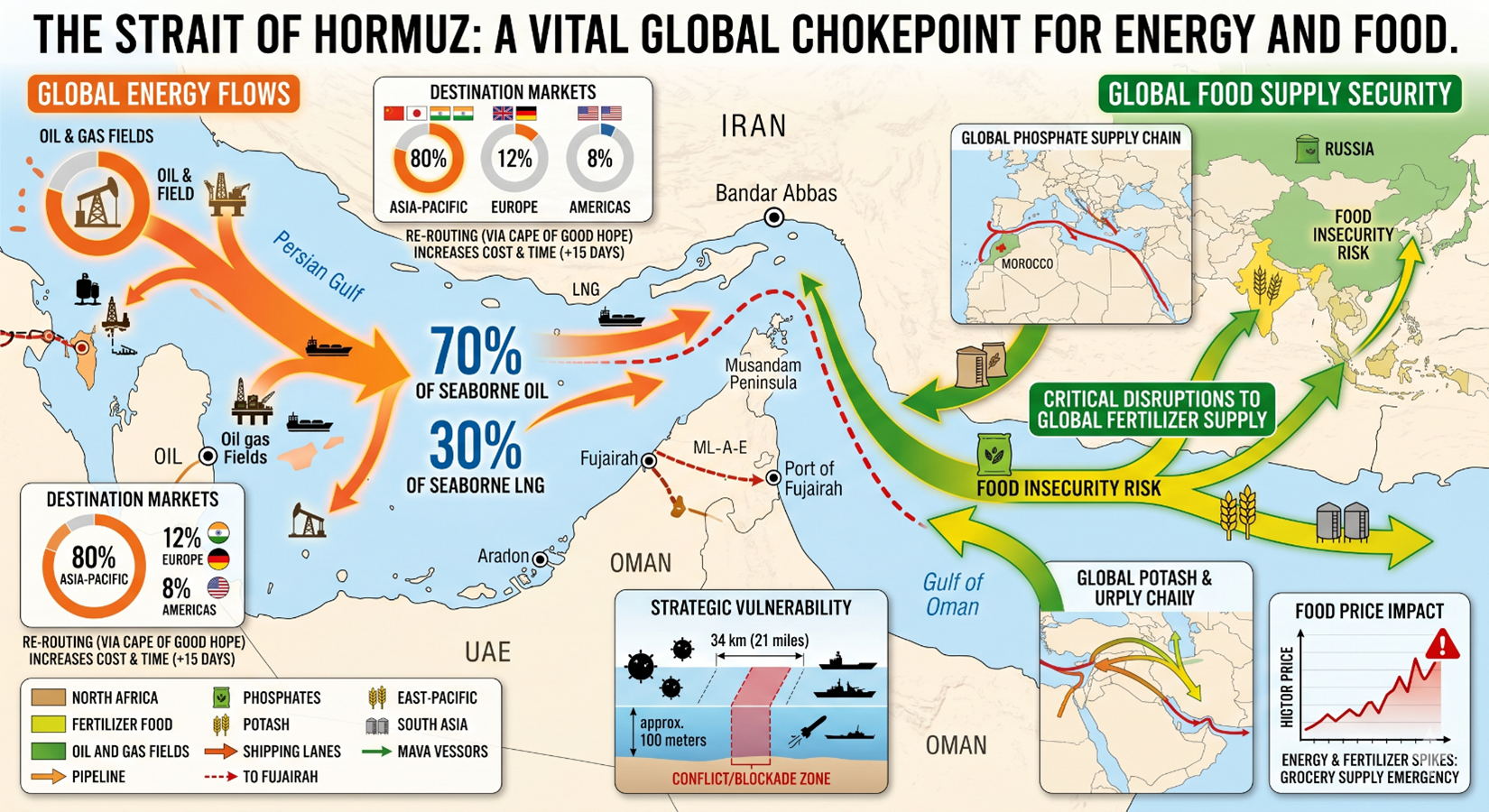

Dire Strait of Hormuz: A Chokepoint for Global Food and Energy

The outbreak of conflict in the Middle East has triggered a multi-layered shock to the global economy and financial markets. The severity of global consequences will depend on the duration of disruptions—particularly to the Strait of Hormuz—and the policy responses of governments and central banks. We approach here the transmission channels through which conflict has affected global energy markets, commodity supply and prices, transportation systems, macroeconomic conditions, and financial markets. Rather than focusing only on oil and gas supply, we trace how the disruption in the Strait of Hormuz and related infrastructure has potentially propagated through shipping, aviation, food costs, remittances, inflation expectations, and central-bank responses. Although short-term disruptions may produce volatility without structural transformation, prolonged conflict risks leading to stagflation, change of trade patterns, and reshaping global financial dynamics.

Continue ReadingDire Strait of Hormuz: A Chokepoint for Global Food and Energy