
July 16, 2026
As the latest U.S. elections were approaching in 2024, we highlighted how proposals on fiscal and trade policies distinguished the two candidates, Donald Trump and Kamala Harris (Canuto, 2024). Here, we take stock of the current U.S. fiscal and debt trajectories, as well as developments on the trade front, midway through the second year of Mr. Trump’s second administration.
The U.S. economy continues to grow faster than its peers among advanced economies, moving on a dual track, where AI-related investments have more than compensated for the negative impacts of Mr. Trump’s trade policies (Canuto, 2025a). On the other hand, the fiscal and debt trajectory toward unsustainability has worsened, while the problems with foreign trade as seen by Mr. Trump have not been helped by his trade policies.
The U.S. is on an unsustainable fiscal path
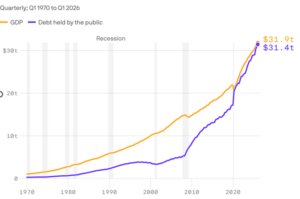
The U.S. Government Accountability Office (GAO) report released on June 11 called for “immediate action to address America’s unsustainable debt path” (GAO, 2026). U.S. federal debt is growing faster than the economy and, for the first time since World War II, federal debt held by the public is projected to exceed the size of the entire national economy, reaching 100.2% of GDP (Figure 1).
Figure 1 – U.S. National Debt and Gross Domestic Product
Source: Irwin (2026)
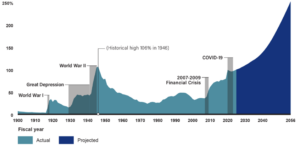
According to the report’s projections, the debt is expected to grow twice as fast as the economy over the next 10 years, reaching 123% of GDP by 2036. Within 30 years, debt held by the public is projected to reach 251% of GDP (Figure 2).
Figure 2 – Debt Held by the Public Projected to Grow Faster than the Economy
Source: GAO (2026)
The GAO itself characterizes this as a structural imbalance between government spending and revenue that has accumulated over two decades, resulting in persistent and growing budget deficits. Historically, the debt-to-GDP ratio would rise during wars and recessions—when spending spiked or revenue fell—and then decline during periods of peace and economic growth. This cyclical correction dynamic has ceased to function over the last two decades.
If the current trajectory is maintained, it is clearly unsustainable in the long run. Given the status of U.S. public debt as a reserve asset for economic agents worldwide—both private and public—current and near-future debt-to-GDP levels do not yet raise concerns about default or non-payment risks. However, if this trajectory continues, debt levels will move well beyond the comfort zone.
Three factors underlying this trajectory are worth noting. First, there are mandatory expenditures with a structural upward trend, including those related to Social Security, Medicare, and other federal health programs. Demographics—specifically an aging population—combined with healthcare costs rising faster than the economy tend to sustain this upward trajectory in the absence of reforms to these programs (Andrade & Canuto, 2024).
Second, tax revenues have not kept pace with spending and are not projected to catch up in the long term under current policies. The Trump tax law passed by Congress last year—the “One Big Beautiful Bill Act” (OBBBA)—which extended exemptions for the upper tier of the income spectrum, tends to worsen the outlook.
Projections by the Tax Foundation indicate that the OBBBA is likely to reduce federal revenue by approximately $5.2 trillion between 2025 and 2034. Even after accounting for potential dynamic effects from economic growth and the spending cuts included in the package, the net cost remains in the range of $4.1–$4.6 trillion over the decade. On the spending side, the package includes net cuts of around $1.2 trillion, with the bulk coming from healthcare (Watson et al, 2026).
Trump spoke of tariff revenues, but these would not suffice; furthermore, tariffs imposed under emergency powers did not survive after being struck down by the Supreme Court. Billions of dollars collected through court-invalidated tariffs are flowing back to payers. Even with Trump’s attempts to rebuild tariff barriers (Canuto, 2026), they can hardly be relied upon as a fiscal remedy.
One should not place too much reliance on tariff revenue. Last year, some projections suggested that tariffs could raise between $2 trillion and $4 trillion over a decade, depending on the methodology and on which tariffs survive legal challenges. But even under the most favorable estimates, this revenue falls short of offsetting the fiscal cost of OBBBA—the tariffs imposed so far will not generate enough revenue to compensate for OBBBA’s impact on the deficit.
In other words, the first-year fiscal package, taken as a whole, adds to the net deficit rather than reducing it. Every projection I am aware of reaches the same quantitative conclusion: the package expands the net deficit, even if projections disagree on the distributional effects and the merits of the policy.
From a strict fiscal-accounting perspective, the picture is reasonably clear: the policy package for the first year of the second term—OBBBA and tariffs—has a net deficit-expanding impact, not a deficit-containing one. The U.S. Government Accountability Office (GAO) projects cumulative deficits of $22 trillion between 2025 and 2034 under current policy, with $4.6 trillion directly attributable to OBBBA. Added to this is an element of institutional uncertainty—the legal validity of tariffs and pressure on Federal Reserve independence—that tends to raise the risk premium demanded by the market, even before considering any direct effect on the budget balance.
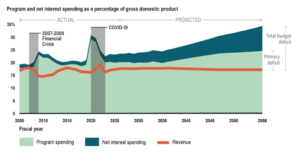
A third factor to consider is the combination of higher interest rates—following the end of the low-interest-rate era that succeeded the global financial crisis—and public deficits could become explosive. Net interest costs will be the fastest-growing component of the federal budget; indeed, by fiscal year 2025, federal net interest spending had already surpassed national defense spending. High debt drives up interest rates, which increases the cost of servicing the debt, widens the deficit, and further increases the debt (Figure 3).
Figure 3 – Interest On Debt Held by the Public Contributes to Growing Budget Deficit
Source: GAO (2026)
It takes only real interest rates exceeding real GDP growth for the debt-to-GDP ratio to rise. No one can say with certainty at what debt-to-GDP levels a vicious cycle between rising risk premiums and debt levels might set in. Japan has reached very high debt-to-GDP levels without triggering insolvency fears or runaway inflation.
Yet some outcome is inevitable—whether an orderly correction through negotiated fiscal reform, an abrupt repricing of the long-term bond market that forces Congress and the executive branch to act under pressure, or, in the most extreme scenario, a flight of buyers.
What does this mean for the U.S. economy?
One can point out the effects already underway as well as more distant “tail risks.” The cost of capital is already higher in the U.S. and worldwide. As debt grows, interest rates tend to rise, further increasing borrowing costs and affecting mortgages, student loans, consumer credit, and corporate capital costs. Interest payments on the national debt—projected to exceed $1 trillion by 2026—are nearly triple the $345 billion paid in 2020.
A “crowding-out” effect on productive investment also tends to occur. When the government absorbs an increasing share of domestic savings to finance deficits, less capital remains available for productive private investment.
Fiscal space to respond to shocks is also reduced, leaving less flexibility to handle unexpected events such as wars or financial crises. This is particularly relevant because the old pattern—where debt rose during recessions or wars and fell afterward—has ceased to function; debt has been growing even during periods of economic expansion, exhausting the very room for maneuver needed for the next recession.
In the medium term, there are potential implications for the dollar’s role and its status as a reserve asset. A permanently deteriorating fiscal trajectory, combined with a loss of market confidence, is the kind of factor that historically erodes—albeit slowly—the “convenience premium” that underpins the dollar as the global reserve currency and U.S. Treasuries as “risk-free” assets (Canuto, 2025b). This is a process spanning years or decades rather than quarters, but risk-pricing logic could shift non-linearly if perceptions regarding repayment capacity deteriorate.
There is a significantly higher risk of a credit rating downgrade compared to what has been seen since the beginning of the last decade. Investors could lose confidence in the nation’s fiscal stability, leading to downgrades of the U.S. credit rating—which, in turn, would further raise borrowing costs in a self-reinforcing cycle.
There are also distributional effects. Those who rely on credit—mortgages, student loans, small businesses—feel the squeeze more directly and immediately than those with established financial assets, who, in many scenarios, benefit from higher real interest rates on savings and bonds.
What distinguishes the current situation is that it is not “just another deficit cycle,” as there is no corrective mechanism of the kind that historically existed. Strong growth alone cannot reverse the trajectory because the problem is structural—mandatory spending growing faster than revenue—rather than cyclical. This means that, without deliberate policy intervention—namely tax reform, curbs on mandatory spending, or a combination of both—the U.S. economy is progressively trading future fiscal flexibility for present fiscal consumption. The cost of this trade-off is paid through higher interest rates, potential inflationary pressure, and reduced capacity to respond to the next crisis, whether financial, geopolitical, or health-related.
How to reverse this scenario and return to a better fiscal position
The U.S. Government Accountability Office report (GAO, 2026) provides an estimate of the scale of the adjustment required. To stabilize the debt at 100% of GDP by 2056—the level already reached today—it would be necessary to run a primary surplus of about 0.2% of GDP annually, starting immediately. This figure rises rapidly with delay: the report’s modeling shows that waiting five or ten years to make the necessary adjustments would require substantially larger changes in spending and revenue to achieve the same goal.
It is worth remembering that the U.S. has done this before: after World War II, when debt also exceeded GDP, it fell dramatically—from over 100% to 34% of GDP over the following two decades. However, that precedent comes with an important caveat: that reduction was achieved through very high real growth, a degree of financial repression—interest rates kept artificially low relative to inflation—and without the demographic burden of Social Security and Medicare that dominates mandatory spending today. Replicating this today is more difficult precisely because the main driver of the current deficit is structural—an aging population and healthcare costs—rather than cyclical—war, recession. There is no “end of the war” to automatically free up spending.
It is a political economy problem: any combination of benefit cuts or tax increases carries an immediate, concentrated political cost for those who implement them, whereas the benefit of avoiding a future crisis is diffuse and distant in time. The question is not whether there is a mathematical path back, but whether there is the political viability to pursue it—and the cost of that path rises the longer one waits.
U.S. versus other G7 economies, such as France
Most advanced economies have faced increasing fiscal pressures—including those stemming from aging, rising interest rates, and higher military spending. The U.S. is not the first G7 country with debt exceeding the size of its economy.
France, for instance, is in the same situation—and France’s position is deteriorating. Public debt stands at around 115–118% of GDP for 2025–26, with projections showing it exceeding 120% in 2027 and rising toward 130% by 2030. The deficit hovers around 5–6% of GDP—well above the EU’s 3% benchmark—and the country continues to run a primary deficit, meaning the books do not balance even when interest payments are excluded.
France cannot resort to independent monetary or exchange-rate policies; therefore, unlike the U.S., it cannot cut interest rates or devalue its currency to offset fiscal tightening. The French case involves a dimension not yet present to the same extent in the U.S.: recurring government collapses. France also relies heavily on foreign investors, who hold 54% of French government bonds—unlike Japan, where public debt is held primarily by domestic investors, despite the country having an even higher debt-to-GDP ratio.
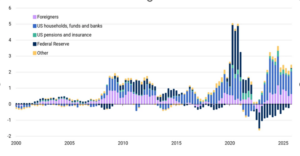
The U.S. issues debt in its own currency, which serves as the global reserve currency; furthermore, despite recurring battles over the debt ceiling, the U.S. has not experienced government collapses lasting weeks, as France has. The proportion of U.S. debt held by foreigners is not especially high (Figure 4).
Figure 4 – Net Treasury purchases, four-quarter rolling sums, $tn, 2000 Q1-2025 Q4
Source: Schamotta (2026).
Where the U.S. represents the greater potential source of shock is in terms of global systemic risk, which depends on scale rather than just proportion. A crisis of confidence regarding French debt—however severe the domestic suffering—has a regional containment mechanism: the ECB can, theoretically, purchase sovereign bonds in unlimited quantities to preserve the integrity of the monetary union, even if the political will for an outright bailout of a government hostile to EU fiscal norms is questionable. Analysts are already drawing parallels with the 1998 Asian financial crisis, suggesting that a French crisis could trigger a broader global sovereign crisis, precisely because the country is too large to be bailed out in the same manner as Greece.
U.S. Treasury bonds, on the other hand, constitute the core collateral underpinning the global financial system. There is no external “U.S. ECB” to act as a backstop, because the Federal Reserve is already the system’s ultimate backstop (Canuto, Coelho & Saraiva, 2026). If confidence in Treasuries were to deteriorate abruptly, there is no supranational institution to contain the contagion—the contagion would be the system itself. In terms of the systemic consequences of a potential loss of confidence, the U.S. poses a categorically greater risk simply by virtue of being the pillar of the international financial system: there is nowhere to “offload” the problem.
Both countries share the same underlying structural cause—an aging population and healthcare/pension costs rising faster than revenue—but France is already paying the price for the lack of a political mechanism to rectify this (higher interest rates, credit rating downgrades, rising risk premiums), whereas the U.S. still benefits from the dollar’s “exorbitant privilege” to delay this market adjustment. This privilege is not permanent—it is precisely what is at stake regarding the long-term trajectory we discussed above.
Channels of transmission to the rest of the world
There are at least four distinct channels through which a U.S fiscal problem is transmitted to the rest of the world, with a disproportionate impact on emerging and developing nations.
First, there is the global benchmark interest-rate channel. U.S. Treasury bonds serve as the risk-free benchmark rate for the global financial system. This means that any deterioration in the perception of the U.S. fiscal risk does not remain contained but propagates to monetary policy rates worldwide. Countries with less domestic “financial repression”—that is, less capacity to force banks and pension funds to absorb sovereign debt at artificially low rates—feel this effect most acutely.
Second, there is the channel involving the U.S. dollar and the global financial cycle. Historically, sharp increases in U.S. interest rates have triggered financial crises in emerging markets. The Latin American debt crisis of the early 1980s, the Asian financial crisis of the late 1990s, and the 2013 “taper tantrum” illustrate how quickly global financial shocks can destabilize emerging economies, typically through shifts in global risk premiums and external financing conditions (Canuto, 2021a).
Third, if the U.S. fiscal trajectory forces the Federal Reserve to keep interest rates higher for longer—to curb inflation fueled by persistent deficits—another transmission channel emerges: higher U.S. interest rates draw capital toward assets perceived as safer, triggering capital outflows, currency depreciation, and tighter financial conditions in other countries. Countries with lower monetary policy credibility and a higher proportion of foreign-currency debt suffer the most severe effects, whereas those with greater credibility and less foreign-currency debt experience far more moderate impacts.
It is worth highlighting a counterpoint revealed by recent data: during the Federal Reserve’s most recent tightening cycle, emerging markets have proven more resilient than in previous episodes. Emerging markets with high monetary credibility and lower foreign-currency debt—precisely the profile that several Latin American countries, including Brazil, have been building in recent years through more robust international reserves and sovereign debt increasingly denominated in local currency—face significantly more moderate spillovers. This does not eliminate the problem, but it means that a country’s degree of exposure depends far more on its own domestic macroeconomic policy—reserves, central bank credibility, debt composition—than on the U.S. trajectory in isolation.
Fourth, there is a specific channel for countries that are major holders of Treasuries. Countries with large concentrations of reserves in U.S. Treasury securities—led by Japan and China—bear currency risk: any abrupt shift in confidence regarding Treasuries causes a drop in the market value of these reserves, creating a political-economy dilemma, given that these same countries rely on the liquidity and depth of the Treasury market as an anchor for their own foreign exchange reserves. It is a form of mutually binding interdependence: no one has an interest in a disorderly correction, which paradoxically sustains demand for Treasuries even in the face of deteriorating fiscal fundamentals—up to the point where this logic no longer holds.
The general pattern is that the U.S. fiscal trajectory does not generate a single, uniform shock—it raises the floor for the global cost of capital, but how each country absorbs this shock depends primarily on its own macroeconomic defenses: international reserves, debt composition—local vs. foreign currency—central bank credibility, and domestic fiscal space. For emerging and developing economies lacking these defenses, the outcome combines the very channels we mentioned above: higher interest rates imported via global arbitrage, exchange-rate pressure, higher sovereign financing costs, and—in extreme cases for the most vulnerable nations—a risk of debt distress amplified by a scenario in which even the system’s benchmark “risk-free asset” is no longer entirely risk-free.
Let us now turn to the foreign trade side.
Why does Mr. Trump see the U.S. trade deficit as a problem?
Mr. Trump’s announcement of “reciprocal tariffs” in April last year was justified as a means to curb the U.S. trade deficit. He mentioned the U.S. as being commercially “raped” by other countries. The formula used to justify tariff levels was directly tied to bilateral trade balances, and the measures collided head-on with the most-favored-nation principle that underpins the WTO’s multilateral trade regime—itself established as part of the exercise of U.S. hegemony (Belhaj & Canuto, 2026).
Tariffs have also been deployed for explicitly “transactional” purposes, serving as bargaining leverage for non-trade objectives—an approach Mr. Trump rehearsed with Mexico during his first term. Rather than leading through free trade agreements, the administration has imposed sweeping tariffs and leveraged U.S. financial power to extract specific concessions from both allies and rivals. It remains to be seen whether the post-EEPA-based tariffs, now that the Supreme Court has dismissed them and a new wall is still being rebuilt, will serve that purpose (Canuto, 2026).
Trump often treats the trade deficit in terms akin to sports or basic accounting: if the U.S. imports more from a country than it exports, it is supposedly “losing money” or getting “ripped off.” In macroeconomic reality, the deficit is a symptom, not necessarily a weakness.
Why does the U.S. have a trade deficit?
The American trade deficit (which has historically hovered around 3% of GDP) does not exist because other countries engage in unfair practices, although geopolitical tensions and subsidies do exist. Rather, it stems from two structural dynamics within the U.S. economy itself.
First, there are consumption and savings patterns. Americans consume far more than they produce and save very little. To finance this consumption and domestic investment, the country needs to import goods from the rest of the world. While the U.S. runs a trade surplus in services, it consistently runs a deficit in trade in goods.
Second, there is the dollar’s ”exorbitant privilege”: because the dollar is the global reserve currency, investors worldwide seek to buy American assets, such as Treasury bonds and stocks (Canuto, 2025b). For the rest of the world to obtain dollars to invest in the U.S., the U.S. must send dollars abroad. The mechanism for doing this is precisely buying more foreign products than it sells.
What substance is there to Trump’s criticism? Although the rhetoric that the U.S. is “impoverishing itself” is false, there are valid concerns regarding the collateral consequences of this situation, which fuel political discourse (Canuto, 2021b). Regional deindustrialization has occurred, as the ease of importing cheaper manufactured goods accelerated factory closures in the so-called Rust Belt. Entire communities lost well-paid, middle-class industrial jobs – even if the idea of an American deindustrialization as a whole is a myth (Arbache & Canuto, 2025). There is also the issue of “strategic dependence”: relying heavily on other countries, particularly China, for critical inputs, electronics, and active pharmaceutical ingredients can create national security vulnerabilities.
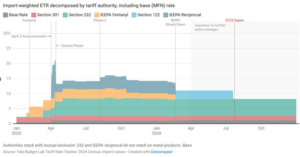
The primary tool Trump advocates to eliminate the deficit is the imposition of aggressive tariffs (import taxes) as depicted in Figure 5a. Figure 5b, in turn, presents the corresponding legal authorities on which these tariffs are based.
Figure 5a – U.S. Daily Effective Tariff Rate
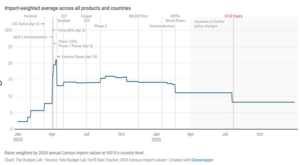
Figure 5b – U.S. Effective Tariff Rate by Authority
However, economists from various schools of thought point out that this strategy tends to fail in achieving its main goal for two reasons:
- Dollar Appreciation: When the U.S. imposes tariffs to reduce imports, the U.S. currency tends to appreciate. A stronger dollar makes American products more expensive abroad, causing exports to fall by a corresponding amount and keeping the deficit intact. On the other hand, the U.S. dollar has experienced significant depreciation since April 2025, when “reciprocal tariffs” were announced on “Liberation Day.” Foreign investors have been hedging their exposure to U.S. assets, further weakening the dollar and prompting discussions about a potential end to the long-standing dollar “super cycle”.
- Cost Pass-through: It is not the foreign exporter who pays the tariff, but rather U.S. importing companies, which pass the cost on to final consumers in the form of higher prices (Hinz et al, 2026).
Sustaining a trade deficit allows the American population to enjoy a higher standard of consumption than domestic production alone would permit—financed by the rest of the world, which has confidence in the stability of the U.S. economy and currency. It is not a “defeat”; it is simply part of the dynamic of being the planet’s leading financial power.
Massive tariff hikes and trade investigations carried out by Trump have undermined confidence in the U.S. as a trading partner
The unilateral imposition of aggressive tariffs and the frequent use of trade investigations, such as those based on “national security” or “unfair practices,” have profoundly altered perceptions of the U.S. as a safe harbor for international trade. What we are seeing on the global stage is a structural shift in how countries and companies view the world’s largest economy.
This erosion of trust is occurring in three main ways.
First and foremost, there has been an end to predictability and a disregard for the rules. Modern global trade was built on the logic of predictability. Multilateral agreements through the World Trade Organization (WTO) and regional blocs, such as the USMCA with Mexico and Canada, served to ensure that the rules of the game would not change overnight. By imposing sudden tariffs—ranging from 10% to 50% for various countries—the White House signaled that domestic emergency laws and presidential decrees take precedence over international treaties. Even though the U.S. Supreme Court blocked some of these specific tariffs, the sense of legal instability remains high.
Furthermore, partnership has been replaced by coercion. Washington’s strategy shifted toward “forced reciprocity” and coercion rather than traditional trade diplomacy. Long-standing strategic partners, such as the European Union, Japan, and India, found themselves targeted by severe surcharges even while cooperating on geopolitical or technological fronts.
For many governments, the message was clear: the U.S. does not distinguish between strategic allies and trade competitors when it comes to supposedly protecting its domestic interests. Trade became a tool for direct political bargaining (demanding, for instance, tighter border controls or alignment on external sanctions). It is also worth noting the acceleration of “global fragmentation” and trade diversion. Instead of forcing the world to passively accept American terms, the aggressive tariff campaign triggered what economists call trade diversion and a quest for autonomy.
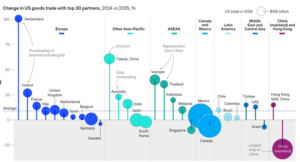
A search for new trade routes began. Affected countries redirected their exports and actively sought alternative markets—including China itself and Europe—to mitigate the risk of over-reliance on the U.S. consumer. Figure 6 shows how the U.S. foreign trade suffered a reconfiguration as an adaptation to country-differentiated trade policy treatments. “Connector countries” came to the fore to circumvent and minimize the impact of U.S. tariffs.
Figure 6 – A small set of European and Asian partners reshaped U.S. trade
Source: McKinsey (2026)
To some extent, retaliatory measures were adopted, even if they were not proportional to the initial U.S. shock. The breakdown of trust sparked waves of tit-for-tat tariffs targeting U.S. agricultural and industrial products, mutually eroding the business environment (Jones, 2026).
The U.S. ceased acting as the “guarantor” and architect of the global financial and trading system it had created in the postwar era, transforming instead into an unpredictable, transactional actor. Although the sheer size of the U.S. consumer market and the power of the dollar prevent the world from simply “abandoning” the U.S., global corporations and governments now factor “American political risk” into their long-term planning. They rely on the strength of the U.S. market, but no longer on the reliability of its treaty commitments.
The U.S. remains the “global consumer of last resort,” as no other country consumes products on the same scale as the United States. In 2025, the country imported more than US$ 4.3 trillion in goods and services.
For export-oriented economies, losing access to the U.S. market or facing heavy tariffs can spell an immediate recession. This dependence is particularly evident among key trading partners. Mexico and Canada have industries and supply chains fully integrated into the U.S. economy through the USMCA trade agreement. Southeast Asia—the ASEAN bloc—and Taiwan have become new hubs for technology exports to the U.S., with Vietnam and Taiwan experiencing explosive growth in exports to the U.S. market and filling part of the gap left by restrictions on China. Even China, despite the ongoing “decoupling” process, still exports hundreds of billions of dollars’ worth of goods to the U.S. annually.
The enduring hegemony of the U.S. dollar also matters. Global trade is not merely physical; it is also financial. Roughly 80% to 90% of global trade transactions are still invoiced in U.S. dollars (Canuto, 2025b).
If a European country wants to trade with an Asian country, the transaction will very likely pass through the U.S. banking system. This infrastructure gives the U.S. the power to dictate the operational rules of trade, regardless of customs tariffs.
There is also a reliance on innovation and high-value services (Arbache & Canuto, 2025). While the rest of the world sells physical products—manufactured goods, ores, food—to the U.S., it buys from Americans the “brains” of the modern economy: intellectual property and patents; financial and cloud services, including the infrastructure of Big Tech and artificial intelligence; and complex capital goods, such as civil aircraft and machinery for advanced semiconductor production.
The world is actively trying to “diversify risk” by seeking alternative routes and strengthening regional blocs but replacing the U.S. consumer market in the short or medium term remains highly difficult. For the global economy, the U.S. is like a difficult, unpredictable customer who complains about prices but buys so much that no one can afford to lose its business.
How much did Trump’s tariffs change the trade balance?
The tariffs do not appear to be addressing the supposed structural problems of U.S. industry, nor are they likely to eliminate the trade deficit. Arbache & Canuto (2025) also challenge the idea that the U.S. is undergoing “de-industrialization.”
Although the Trump administration points to isolated victories and temporary reductions in deficits with specific countries, such as China or Canada, global economic data show that the tariff remedy produced side effects that offset the intended benefits. The actual balance sheet of these measures reveals their practical impact on the U.S. economy.
First, the industrial “boom” never materialized, and jobs were lost. The central promise was that tariffs would force companies to reopen factories in the U.S.—so-called “reshoring”. In practice, however, employment in the U.S. industrial sector declined.
Costs also rose, as U.S. industry relies heavily on imported parts, steel, and aluminum. Tariffs drove up production costs, meaning that a car or appliance factory in the U.S. faced higher expenses for domestic production.
There were also job losses: data from the Congressional Economic Committee and the Federal Reserve indicate that, far from a “renaissance,” the manufacturing sector lost approximately 108,000 jobs in the first year following the aggressive wave of tariffs. The gains from protecting local producers were completely offset by the losses suffered by industries relying on imported inputs.
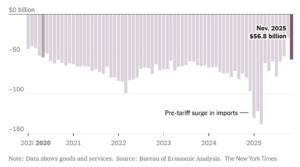
Furthermore, the trade deficit simply shifted elsewhere. The notion that tariffs would reduce the overall trade deficit ran up against macroeconomic realities. In 2024, prior to the harshest tariffs, the goods deficit stood at around $904 billion; in 2025, after the imposition of heavy barriers, it closed at virtually the same level—$902 billion (Figure 7). The U.S. did reduce its deficit with China, but American consumption remained high. As a result, companies simply shifted their supply chains to countries such as Vietnam, Taiwan, and Mexico, increasing the deficit with these new partners, as shown above in Figure 6 (Swanson, 2026). The overall trade gap remained unchanged.
Figure 7 – U.S. Trade Deficit
Third, there was a slowdown in investment and agricultural retaliation. Instead of fostering security, the tariffs created an environment of significant legal uncertainty. Companies postponed long-term investments in industrial infrastructure because they did not know which raw material would next face a tariff by executive order. Furthermore, other countries retaliated by imposing tariffs on key U.S. exports—such as soybeans, pork, and technology products—thereby shifting part of the economic burden from the manufacturing sector to American agribusiness.
Where did real growth occur? The recent surge in the construction of high-tech factories in the U.S., such as semiconductor and battery plants, has been driven far more by the massive cash subsidies and tax incentives approved in recent years—such as those provided under the CHIPS Act—than by the imposition of trade barriers and tariffs. Additionally, a bright spot in recent economic performance has been the boom driven by artificial intelligence (Canuto, 2025a).
Tariffs served as a modest revenue-generating tool for government coffers and as a politically potent message that resonated with the public, but they failed to “cure” the domestic manufacturing sector. Modern industry operates within global production networks; attempts to isolate it forcibly ended up driving up production costs within the United States itself.
How could the U.S. restore its status as a reliable trading partner?
Fully restoring the United States’ image as a completely predictable trading partner is a complex challenge, primarily because the world has realized that U.S. foreign policy now swings drastically depending on who occupies the White House.
Even so, it is possible to mitigate this skepticism. To regain the trust of global markets and governments, the U.S. needs to shift from a model of “confrontation and unilateral executive action” to a more institutionalized one. Historically, such a restoration would require action on four main fronts.
First and foremost, the U.S. would need to institutionalize the rules—swapping Twitter for treaties. The biggest global complaint concerns the unpredictability of tariffs announced without warning through executive orders. To restore confidence, the U.S. government would need to return greater authority to Congress. The U.S. Constitution assigns control over trade to the legislative branch. Moving away from the indiscriminate use of “national emergency” laws, such as Section 232 regarding steel and aluminum, and requiring congressional approval for new tariffs would signal to the world that trade barriers will not change at the president’s mere whim. Along the same lines, signing binding agreements is crucial: instead of relying on “gentlemen’s agreements” or temporary truces, Washington would need to conclude formal, long-term trade treaties featuring strict penalty clauses for non-compliance by either party.
The U.S. should also reform the World Trade Organization (WTO) rather than boycott it. The country has paralyzed the WTO’s Appellate Body by blocking the appointment of judges, effectively preventing other countries from legally challenging its tariffs. To be viewed once again as a reliable and principled partner, U.S. diplomacy needs to lead an internal reform of the WTO, updating its rules to address modern state subsidies—the primary issue regarding China—instead of simply dismantling the international dispute-settlement system.
It would also be appropriate to focus on partnerships based on shared values, or “friend-shoring.” Rather than adopting a “U.S.-versus-the-rest-of-the-world” stance, the most effective strategy for restoring prestige is friend-shoring: redirecting supply chains toward allied and democratic nations. By establishing robust trade blocs with the European Union, Japan, Taiwan, and countries across the Americas, the U.S. could protect its national interests and secure supplies of semiconductors and critical minerals without imposing sweeping, punitive tariffs on its allies.
More broadly, the goal should be to offer “win-win” scenarios. Recent American rhetoric views trade as a zero-sum game, in which, for the U.S. to win, someone else must lose. To be seen as a reliable partner, Washington needs to return to proposing agreements under which both sides prosper—by integrating digital markets, aligning energy-transition standards, and strengthening intellectual property protections.
The fundamental question is not how to do this, but whether Washington’s domestic political landscape will allow the U.S. to forgo using its immense economic power as a tool for immediate political leverage.
References
Andrade, E. & Canuto, O. (2024). Demographic Dynamics and Immigration Policies in High-Income Countries, Policy Center for the New South, PP – 03/24, April.
Arbache, J. & Canuto, O. (2025). The Myth of American Deindustrialization, Project Syndicate, September 2.
Belhaj, F. & Canuto, O. (2026). The Silent Majority of the New South: Small States, Davos 2026, and the Last Line of International Law, Policy Center for the New South, PB-05/26, February.
Canuto, O. (2021a). Will Another Taper Tantrum Hit Emerging Markets? Project Syndicate, July 14.
Canuto, O. (2021b). Climbing a High Ladder – Development in the Global Economy, Policy Center for the New South.
Canuto, O. (2024). The U.S. Elections Will Have Worldwide Economic Consequences, Policy Center for the New South, September 5.
Canuto, O. (2025a). The Global Economy Is on a Two-Way Track, Policy Center for the New South, PB – 47/25, October.
Canuto, O. (2025b). De-Dollarization, Local Currencies, And External Financial Defense, Policy Center for the New South, RP – 07/25, August 19.
Canuto, O. (2026). President Trump’s Post-Emergency Tariff Wall, Policy Center for the New South, March 3.
Canuto, O.; Coelho, D.R. & Saraiva, B. (2026). Global Imbalances and Geopolitical Fragmentation, Policy Center for the New South, PP – 15/26, June.
GAO – U.S. Government Accountability Office (2026), The Nation’s Fiscal Health: Urgent and Sustained Action Needed to Improve the Fiscal Outlook June 11.
Hinz, J.; Lohmann, A.; Mahlkow, H.. & Vorwig, A. (2026). Americaʼs Own Goal: Who Pays the Tariffs? Kiel Institute for the World Economy, January.
Irwin, N. (2026). What is, and isn’t, worrying about 100% debt to GDP, Axios, May 4
Jones, C. (2026). ‘Tit-for-tat’ trade warfare threatens global economy, says IMF chief economist, Financial Times, June 26.
McKinsey (2026). Geopolitics and the geometry of global trade: 2026 update, March 19.
Schamotta, K. (2026). US Treasury market is living on borrowed time, OMFIF, June 17.
Swanson, A. (2026). U.S. Trade Deficit Widens Despite Trump’s Tariffs, The New York Times, January 29.
Watson, G.; Li, H.; York, E.; Muresianu, A.; Cole, A.; Van Ness, P. & Durante, A. (2026). One Big Beautiful Bill Act Tax Policies: Details and Analysis, Tax Foundation, February 10.
Otaviano Canuto, based in Washington, D.C, is a former vice president and a former executive director at the World Bank, a former executive director at the International Monetary Fund, and a former vice president at the Inter-American Development Bank. He is also a former deputy minister for international affairs at Brazil’s Ministry of Finance and a former professor of economics at the University of São Paulo and the University of Campinas, Brazil. Currently, he is a senior fellow at the Policy Center for the New South, a professorial lecturer of international affairs at the Elliott School of International Affairs – George Washington University, a nonresident senior fellow at Brookings Institution, a professor affiliate at UM6P, and principal at Center for Macroeconomics and Development.