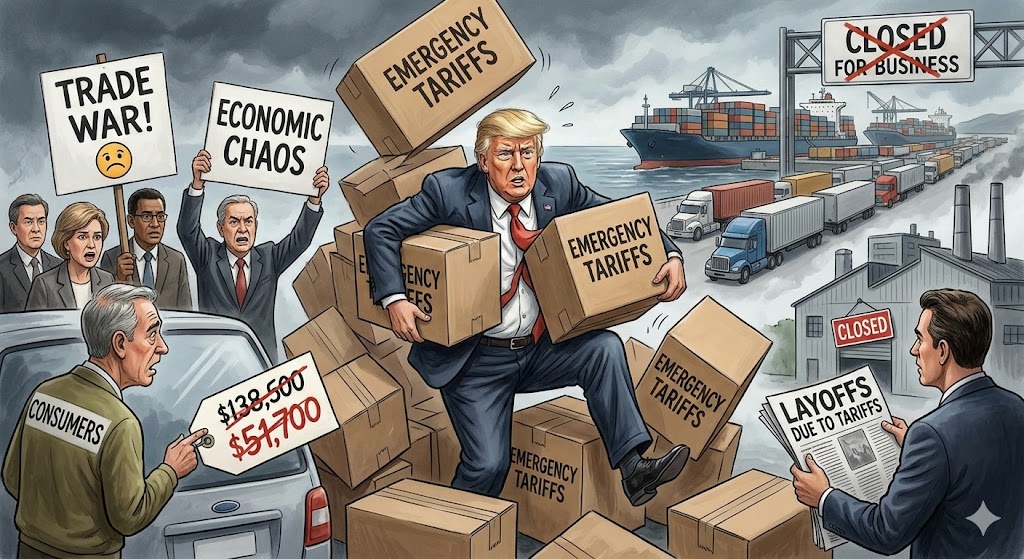
The fiasco of Mr. Trump’s emergency tariffs

The IEEPA tariff journey did not end well. It turned out to be an illegal tax based on flawed economic principles, was reluctantly revoked under belated legal pressure, and compensated those who were said to be the object of "punishment."  The insistence on seeking punishment through other legal means risks extending the fiasco, keeping uncertainty high along the way.

Continue ReadingThe fiasco of Mr. Trump’s emergency tariffs

The American Industrial Transformation: Beyond the Deindustrialization Myth

What the U.S. has lost in domestic manufacturing, it may have gained in global productive presence. Understanding the transformation of U.S. manufacturing requires an assessment of the revolutionary impact of technology. Tomorrow’s industrial jobs require completely different qualifications from yesterday’s, and even successful production reshoring wouldn't necessarily restore the industrial employment levels of previous decades. Some confusion about U.S. ‘deindustrialization’ also arises from how sectoral GDP is measured. A significant share of value added in industrial production, especially high-value activities, is classified as ‘services’. The deindustrialization narrative, and the political platform of ‘Make America Great Again’ by reindustrializing it, reflects an identification between the evolution of U.S. manufacturing during globalization and the unequal appropriation of economic gains by the top of the income pyramid. The real strategic question for the U.S. isn't how to compete with China in low value-added goods production, but how to maintain and expand its leadership in high-tech segments, design, innovation, and global value chain coordination.

Continue ReadingThe American Industrial Transformation: Beyond the Deindustrialization Myth

The global economy is on a two-way track

Global economic growth has been more resilient than expected, as the artificial intelligence-led growth seems to be compensating for the negative impacts of trade conflicts. Overstretched asset values and slowing jobs growth may be signaling that the balanced crossing of those two paths will be challenged.

Continue ReadingThe global economy is on a two-way track

The U.S. Elections Will Have Worldwide Economic Consequences

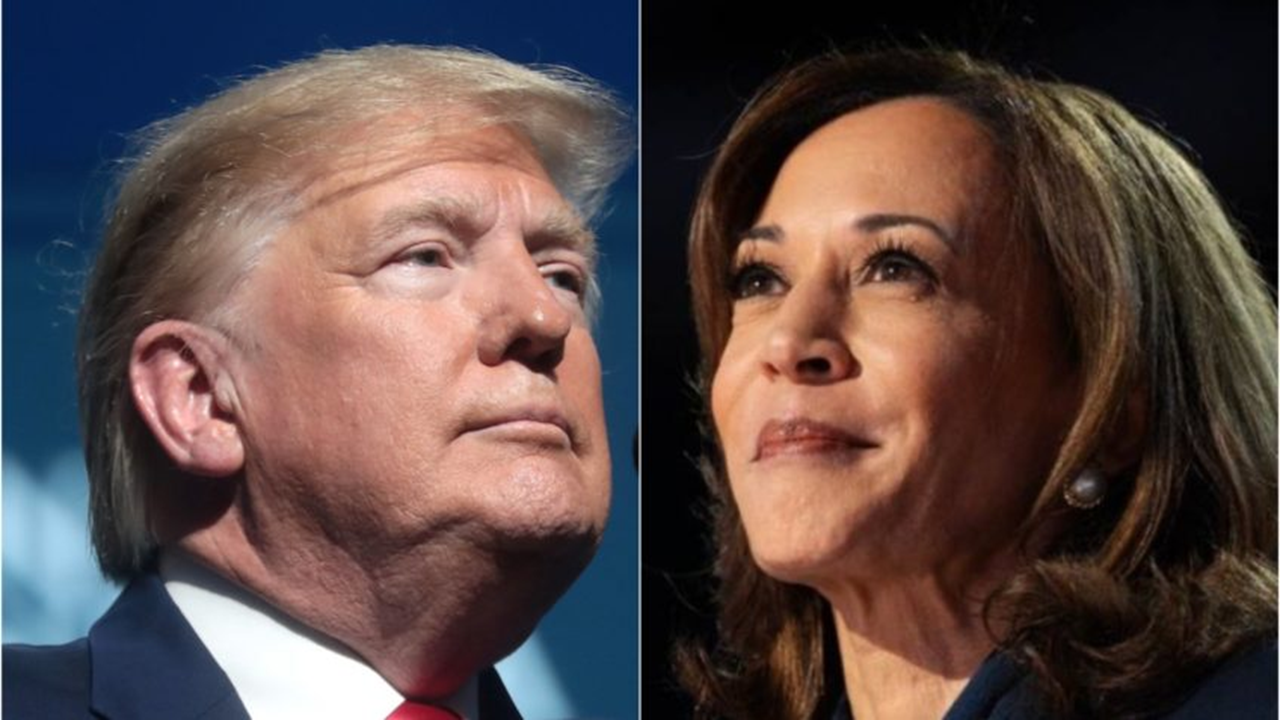
Kamala and Trump have different proposals regarding tariffs, taxes, energy and immigration. If you believe that the ongoing global warming is due to carbon emissions and desire a transition to renewable energy worldwide, and if you believe that trade between countries is not a “zero-sum game”, you already know who you will be rooting for.

Continue ReadingThe U.S. Elections Will Have Worldwide Economic Consequences

A Tale of Two Technology Wars: Semiconductors and Clean Energy

The global economic environment has changed as the U.S.—and to a less confrontational degree, the European Union—have clearly established a context of technological rivalry with China. Hindering China’s progress in the sophistication of semiconductor production has become a centerpiece of current U.S. foreign policy. While the U.S. is clearly winning the semiconductor war, the picture is different when it comes to clean-energy technology. Both technology wars overlap with access to and refinement of critical raw materials (CRM), which are key upstream components of the corresponding value chains, encompassing mineral-rich emerging markets and developing economies. The way in which the U.S. and the European Union approach the goal of self-sufficiency, as well as access to and refinement of CRMs, will make a big difference to their stakes in the technology wars.

Continue ReadingA Tale of Two Technology Wars: Semiconductors and Clean Energy

An “unthinkable” U.S. public debt default

The nominal debt ceiling is a crude and rudimentary barrier against excess public debt in the United States. Hope remains that the White House and Republicans will reach a deal on raising the debt ceiling in time to avoid what Secretary Yellen called "unthinkable" and "catastrophic". Some framework to deal with fiscal matters is needed, instead of nominal spending caps. But this transition need not happen via financial shocks and a possible default on public debt.

Continue ReadingAn “unthinkable” U.S. public debt default

The Fed’s Focus on the Labor Market

Monetary tightening is aimed at slowing demand growth relative to aggregate supply, which will require a sustained period of below-trend US economic growth. It is in the labor market that the Fed's monetary policy script will be written. Judging by Powell's presentation last week at Brookings, and given the outstanding fears of price-wage spirals.

Continue ReadingThe Fed’s Focus on the Labor Market

Is the U.S. Economy in Recession?

There are reasons to consider the US recession call as currently premature , even recognizing clear and undeniable signs of an economic growth slowdown at the margin. As suggested by the resilience of private consumption in the second quarter, the labor market remained tight. Markets have come to assign a high probability that the Fed will “pivot”, and reverse its tightening direction, given signs of an economic slowdown. It seems premature to bet on such a "pivot" by the Fed, and the recent refreshment of stock and bond markets tends to be reversed. Two points remain unclear: if the economy does indeed fall into a recession, how shallow or deep will it be? How rigid downward will the inflation rate measured by its core turn out to be?

Continue ReadingIs the U.S. Economy in Recession?

Sanctions against Russia resemble boxing matches

The economic sanctions against Russia announced last week by the United States and Europe following the military invasion of Ukraine are having a profound impact on the Russian economy while also having repercussions at home. As in a boxing match, the expectation is that blows to the opponent can knock them out, despite the exposure on the punching side.

Continue ReadingSanctions against Russia resemble boxing matches

U.S. Bubble-Led Macroeconomics

Macroeconomic dynamics in the U.S. economy has increasingly become associated with asset price fluctuations in the past few decades. Financial conditions have increasingly become an influential factor shaping the cyclical pace of the macroeconomy. There has been a mismatch between rising financial wealth and the pace of creation and incorporation of new assets. Several secular stagnation hypotheses offer explanations for the insufficient creation of new assets. Public debt—and its partial monetization by central banks—has played a stabilizing role by boosting the net supply of assets available to accommodate the demand for financial assets. The U.S. big balance sheet economy has been on a growth path highly dependent on the continuity of low real interest rates, as well as stretched price-earnings ratios of stocks and high corporate debt. Periodic episodes of downward adjustment of asset prices have been countervailed with lax monetary policies.

Continue ReadingU.S. Bubble-Led Macroeconomics
Read more about the article Will Another Taper Tantrum Hit Emerging Markets?
Finance investment stock market chart graph currency exchange global business fintech ++The World map texture derived from public domain NASA: http://visibleearth.nasa.gov. Traced in Illustrator. File created on November 29 2018++

Will Another Taper Tantrum Hit Emerging Markets?

Market movements this month have led to renewed fears that changes in US financial and monetary conditions will trigger a painful wave of capital flight from emerging markets, as happened in 2013. But times have changed, and the greatest risks to emerging markets now lie elsewhere.

Continue ReadingWill Another Taper Tantrum Hit Emerging Markets?

The size of Biden’s fiscal package

According to Treasury Secretary Janet Yellen, it would be better to run the risk of excess than insufficiency. In addition, the Federal Reserve's new monetary policy regime puts the 2% inflation target as an average, not as a ceiling forcing monetary policy to act to prevent it in advance. After a long period of inflation below 2%, even in years with low unemployment and interest rates on the floor, monetary authorities can afford to wait some time with above-average inflation until they are compelled to pull the brake.

Continue ReadingThe size of Biden’s fiscal package

Whither Interest Rates in Advanced Economies: Low for Long?

The action of central banks has been more reactive than proactive, more reflex than cause, and in their absence, macroeconomic performance would have been even more mediocre than it has been. There is a mismatch between the trend of increasing stocks of financial wealth, occasionally cut by shocks and crises, and the creation and incorporation of new assets accompanying economic expansion. COVID-19 is helping reinforce such trends.

Continue ReadingWhither Interest Rates in Advanced Economies: Low for Long?

Shapes of post-coronavirus economic recovery

Data recently released on the first-quarter global domestic product (GDP) performance of major economies have showed how significant the impact of COVID-19 has been on economic activity and jobs, with large contractions across the board. The ongoing global recession is poised to be worse than the “great recession” after the 2008-09 global financial crisis, especially from the standpoint of emerging market and developing economies. The depth and speed of the GDP decline will rival that of the Great Depression of the 1930s. But how swiftly will national economies recover once the pandemic has passed? And when will that happen? That will depend on how successful the containment of coronavirus and exit strategies will be, as well as on how cost-effective will be the policies designed to deal with the negative economic effects of coronavirus.

Continue ReadingShapes of post-coronavirus economic recovery