
Policy Center for the New South, Policy Brief PB – 48/25 October 2025
Seeking Alpha
Jorge Arbache and Otaviano Canuto
Conventional wisdom holds that the United States has undergone massive deindustrialization in recent decades, with the country’s manufacturing sector supposedly withering as it lost ground to China. This narrative has fueled debates about industrial policy, economic nationalism, and the reshoring of manufacturing production. But what if this story is only partly true? What if, instead of disappearing, American industry simply changed its address, becoming worldwide?
The Complexity of Numbers: Beyond Top-level Statistics
A closer examination of the data suggests that what the U.S. has lost in domestic manufacturing, it may have gained in global productive presence. Rather than collapsing, American industry has internationalized strategically and deliberately, reflecting a fundamental transformation in the nature of global industrial competition.
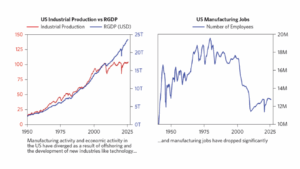
Manufacturing’s share of U.S. GDP has indeed declined significantly. In 1970, the sector accounted for roughly 24% of the American economy; by 2023, it represented less than 11%. Figure 1 (left panel) shows how industrial production has flatlined while real GDP (RGDP) grew exceptionally well.
Industrial employment has also fallen dramatically, by nearly seven million jobs since the 1970s peak (Figure 1, right panel). These figures are frequently cited as irrefutable evidence of American industrial decline and have shaped public perceptions and political debates for decades.
Figure 1 – U.S. Industrial Production and Manufacturing Jobs
Source: Debois et al (2025).
However, this simplified narrative ignores profound and simultaneous structural transformations. The U.S. economy underwent a transition toward higher value-added activities, a process economists call ‘industrial upgrading’. This phenomenon doesn’t necessarily represent decline, but rather evolution toward more sophisticated forms of productive organization.
These figures have supported the notion that the U.S. ‘abandoned’ its industry. But several additional points warrant careful consideration. First, as technology evolved, manufacturing employment per unit of output shrank across many developed nations. Germany, for instance, maintained continued manufacturing success, while experiencing declining industrial employment. This is a global phenomenon, not unique to the U.S. Japan, South Korea, and countries including France and the United Kingdom, have experienced similar trajectories of declining industrial employment, while maintaining or expanding their productive capabilities.
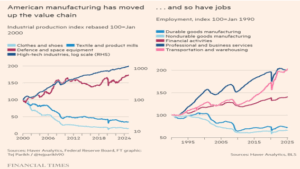
Second, U.S. real (inflation-adjusted) manufacturing value added has risen over the past four decades, even if levels of industrial production have stabilized in recent years and factory jobs have declined (Figure 1). The gap between input costs and net output value shows an upward trajectory, indicating greater efficiency and technological sophistication. The sector’s composition has been characterized by a growing share of higher value-added goods, including advanced technologies, aerospace products, precision medical equipment, cutting-edge semiconductors, and innovative pharmaceuticals, manufactured with fewer workers and exponentially higher levels of automation and artificial intelligence (Figure 2).
Figure 2 – U.S. Manufacturing and Jobs Have Climbed the Value Chain
Source: Parikh (2025).
The Technological Revolution in U.S. Manufacturing
Understanding the transformation of U.S. manufacturing requires an assessment of the revolutionary impact of technology. The introduction of advanced automation systems, intelligent robotics, additive manufacturing (3D printing), the industrial Internet of Things (IoT), and artificial intelligence has fundamentally transformed the fundamental nature of production.
These technologies have enabled U.S. companies to maintain global competitiveness despite higher labor costs. A modern General Electric or Ford plant today produces far more value with a fraction of the workers needed decades ago. The remaining workers operate at dramatically superior skill and productivity levels, controlling complex systems that would have been unthinkable in the previous industrial era.
This technological transformation also explains why policies focused simply on ‘bringing jobs back’ may be fundamentally misguided. Tomorrow’s industrial jobs require completely different qualifications from yesterday’s, and even successful production reshoring wouldn’t necessarily restore the industrial employment levels of previous decades.
The Chinese Paradox and Territorial Production Measurement
During the U.S.’s transformation period, China emerged as a manufacturing powerhouse. By 2023, it was the world’s largest industrial producer, with estimated value added reaching $4.6 trillion—nearly double the U.S.’s $2.8 trillion. But concluding that this signals a decline in U.S. industrial leadership overlooks a crucial fact: the data used here—such as industrial value added—are calculated based on national territory, measuring only what is physically produced within a country’s borders.
This methodology parallels the distinction between GDP and GNP (gross national product) but applied specifically to manufacturing. GDP measures all production within national borders, regardless of production factor ownership, while GNP measures production controlled by national residents, regardless of geographical location.
The problem with this territorial measurement method is that it misses a fundamental feature of the twenty-first-century economy: production chain internationalization. Large U.S. companies maintain extensive overseas production networks through wholly-owned subsidiaries, strategic joint ventures, or contracts with local suppliers. This production is often shaped, supervised, and controlled by engineers, designers, and executives in the U.S., even when it occurs physically elsewhere.
The Reality of U.S. Global Manufacturing
Therefore, U.S. manufacturing hasn’t disappeared; it has strategically relocated. U.S. factories operating in Europe, Asia, Latin America, and other regions supply local and global markets, while integrating global value chains under U.S. control. This transformation represents one of the most significant changes in global industrial organization since the Industrial Revolution.
Data from the U.S. Bureau of Economic Analysis (BEA) indicate that by 2024, the stock of U.S. direct investment in overseas manufacturing was approximately $1.1 trillion, while the corresponding figure for China was estimated at around $200 billion. This disparity is remarkable and reveals the extent of U.S. control over global production.
To contextualize these numbers, U.S. overseas direct investment in manufacturing exceeds many developed countries’ GDPs. Companies such as Apple, which technically ‘manufactures’ its products in China through partners such as Foxconn, maintain complete control over design, specifications, quality standards, supply chains, and distribution. The majority of economic value generated by an iPhone—estimated at 60%-70%—remains with Apple in the United States, even though physical assembly occurs in Asia.
Similar cases include companies such as Nike, which designs and markets footwear manufactured in dozens of different countries, but captures the largest value share through its U.S.-based research and development, marketing, and distribution activities. General Motors produces vehicles in over 30 countries, but strategic decisions, platform development, and advanced technologies remain centralized in its U.S. operations.
These overseas industrial operations don’t appear in conventional national accounts, creating a distorted picture of true U.S. industrial capacity. By measuring only domestic production, we dramatically underestimate the true scale of U.S.-controlled manufacturing. BEA statistics actually suggest that including overseas production controlled by U.S. companies, U.S. ‘global manufacturing value’ could reach $3.9 trillion—much closer to China’s total, and potentially exceeding it when taking into account all control and value capture variables.
Case Studies: How U.S. Global Manufacturing Works
To illustrate how the model operates, consider specific examples. Boeing, the U.S.’s largest exporter (Isidore, 2025), coordinates a global supplier network including Japanese companies manufacturing fuselage components, European suppliers producing avionics systems, and U.S. companies developing engines. Boeing maintains control over design, systems integration, testing, certification, and commercialization—the highest value-added activities.
Similarly, U.S. pharmaceutical companies such as Pfizer and Johnson & Johnson conduct research and development in the U.S., but manufacture products in global facilities optimized for different markets and regulations. Economic value concentrates in knowledge-intensive activities based in the U.S., while physical production distributes globally to maximize efficiency and market proximity.
The importance of U.S. overseas manufacturing is supported by various data sources and may help explain why U.S. stock markets suffered less than U.S.-based workers during industrial restructuring periods. Shareholders of major U.S. corporations continued to benefit from profits generated by global production, even when domestic manufacturing jobs were lost. This divergence between capital market performance and domestic industrial employment reflects the globalized nature of contemporary U.S. industry.
The Complexity of Chinese Exports
Moreover, not all Chinese exports are entirely ‘made in China’. According to OECD data, part of Chinese export value corresponds to inputs imported from third countries, potentially meaning less that than 65% of Chinese manufactured export value is generated within China. In the U.S. case, this share is around 80%, indicating that U.S. companies capture more value added in stages under their control.
This phenomenon reflects the fragmented nature of modern global value chains. A product ‘made in China’ may contain German components, U.S. software, Italian design, and Brazilian materials. China, in many cases, serves as the final assembly location but not necessarily as the value creation center of the production chain.
The Misclassification of Industrial Services
Some confusion about U.S. ‘deindustrialization’ also arises from how sectoral GDP is measured. A significant share of value added in industrial production, especially high-value activities, is classified as ‘services’. Advanced logistics, research and development, specialized engineering, software development, patent management, global branding, international distribution, industrial design, and supply chain management (among others) are fully integrated into manufacturing but counted in a different economic category (Arbache and Canuto, 2025).
This inadequate classification obscures the true contribution of America’s industrial base. When a company such as Boeing coordinates production using global suppliers, most U.S. value added isn’t recorded as manufacturing, despite being deeply connected to it. Boeing controls design, engineering, systems integration, testing, certification, and commercialization, which are all high-value activities classified as services.
Aggregating manufacturing capabilities with service functions directly tied to the sector reveals a U.S. industrial footprint that appears to surpass China’s in terms of value and technological sophistication.
Control Versus Location: The New Industrial Paradigm
The real question, then, isn’t just how much is produced and where (the obsession of President Donald Trump and many contemporary politicians). It’s about who controls and captures value from industrial supply chains. From this perspective, the U.S. remains highly industrialized, though through a sophisticated and globalized business model.
Control over global value chains confers significant economic and geopolitical power. U.S. companies controlling these chains can influence global standards, direct technological innovation, determine where new investments are made, and capture the largest shares of profits generated by global production.
Contemporary Industrial Policy Implications
This reality has significant implications for debates about reindustrialization, trade, tariffs, and industrial policy. The issue isn’t just ‘bringing factories back’, but understanding who is in control, where value is generated, and how production networks can be organized in more resilient, efficient, and sustainable ways.
Policies focused exclusively on physical production relocation may be counterproductive if they don’t take into account the integrated nature of modern value chains. A more sophisticated approach would recognize that twenty-first-century industrial leadership depends as much on the ability to coordinate global networks, as on maintaining domestic productive capabilities in strategic sectors.
The Hidden Costs of Forced Relocation
However politically convenient the deindustrialization narrative may be, the reality is more complex and less gloomy than many assume. The U.S. may have lost factories, but it hasn’t lost industrial capacity. Its capacity has simply become transnational and, in many respects, more powerful and flexible.
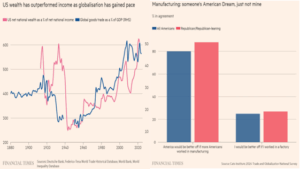
The deindustrialization narrative, and the political platform of ‘Make America Great Again’ by reindustrializing it, reflects an identification between the evolution of U.S. manufacturing during globalization and the unequal appropriation of economic gains by the top of the income pyramid (Figure 3, left panel). The association can be seen in the population’s opinion about how good manufacturing job increases would be for the country, compared to the lower preference for those jobs (Figure 3, right panel).
Figure 3 – U.S. Wealth and Income. U.S. Opinions on Manufacturing Jobs
Source: Parikh (2025).
Efforts to reshore labor-intensive parts of the supply chain through reshoring policies and tariffs have had smaller impacts on U.S. manufacturing than promised by proponents of such policies. The sector’s renaissance would come at the expense of higher value-added activities, because U.S. businesses would need to reallocate limited skilled labor resources to less-productive activities.
This forced resource reallocation represents a significant opportunity cost. Engineers and scientists who could develop next-generation technologies would be redirected to supervising commodity production. Capital that could finance research and development would be invested in production equipment for low value-added goods that other countries can produce more efficiently.
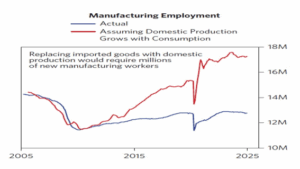
That can be gauged in the simulation by Debois et al (2025) of what would it take in terms of manufacturing jobs for the U.S. to replace entirely imported goods with domestically produced goods (Figure 4). Besides the inefficiency aspects of labor relocation, there is the fact that current anti-immigration policies tend to aggravate the labor-supply scarcity (Estevão et al, 2025).
Figure 4 – U.S. Manufacturing Employment
Source: Debois et al (2025).
Low-income families currently benefiting from low-cost imported goods would face higher prices, with or without domestic supply chain establishment. Economic studies suggest that forced industrial relocation costs fall disproportionately on lower-income consumers, who spend larger portions of their incomes on basic manufactured goods.
International Lessons and Alternative Models
The experiences of other developed countries offer valuable insights into different approaches to industrial transformation. Germany, frequently cited as a manufacturing success example, actually underwent transformations similar to those in the U.S., but maintained a different political narrative. The German ‘Industrie 4.0’ concept explicitly recognizes that manufacturing’s future lies in integrating digital technology, advanced automation, and global production networks.
Japan developed the concept of ‘monozukuri’—a philosophy emphasizing manufacturing pride and continuous improvement. But even the most traditional Japanese companies operate extensive global production networks. Toyota, symbol of the Japanese production system, produces vehicles in dozens of countries, adapting operations to local conditions while maintaining central control over standards and technology.
Switzerland represents another interesting model: a country with even higher labor costs than the U.S., but which maintains a strong manufacturing base focused on ultra-high value-added products, including precision equipment, pharmaceuticals, and advanced technology. Swiss companies compete globally not through low costs but through superior innovation and exceptional quality.
Attempting to recreate yesterday’s manufacturing sector won’t just fail. It will make Americans poorer by forcing the economy to regress toward less-efficient production models. Economic history shows that countries that resist inevitable structural transformation inevitably fall behind in global competition.
The Future of Industrial Leadership
At a time of geopolitical realignment, trade tensions, and energy transition, understanding this nuance is essential. Manufacturing’s future isn’t just about factory floors, which are increasingly populated by robots and automated systems. More importantly, it’s about where, how, and with whom to produce, and about who captures the resulting profits and influence.
The real strategic question for the U.S. isn’t how to compete with China in low value-added goods production, but how to maintain and expand its leadership in high-tech segments, design, innovation, and global value chain coordination. This is a more sophisticated and sustainable form of industrial leadership, suited to twenty-first-century realities.
The industrial transformation of the U.S. represents not decline, but evolution toward more advanced forms of productive organization. Recognizing this reality is fundamental to developing effective industrial policies that strengthen America’s competitive position, without sacrificing the advantages of global specialization. The challenge lies not in turning back the clock, but in ensuring that the benefits of this transformation are more broadly shared while maintaining America’s technological and organizational edge in an increasingly competitive global economy.
References
Arbache, J. and Canuto, O. The Myth of American Deindustrialization, Project Syndicate, September 2.
Debois, D.; Madigan-Curtis, A.; Dunbar, K.; and Wilks, K. (2025). What would it take to bring back US manufacturing? Part1: America’s structural headwinds, Bridgewater, July 2.
Estevão, M.; Bonifacio, V.; Castellano, M.; Figueroa, M.P.; and Raman, N. (2025). U.S. migration shocks and remittances, Institute of International Finance – IIF, September.
Isidore, C. (2025). America’s biggest exporter was already on the ropes. Then came tariffs, CNN Business, April 23.
Parikh, T. (2025). Nostalgia for manufacturing will make the US poorer, Financial Times, April 13.
Jorge Arbache, Professor of Economics at the University of Brasília, is a former deputy minister and chief economist at Brazil’s Ministry of Planning, vice president for the private sector at the Development Bank of Latin America and the Caribbean, board member at BNDES, and senior economist at the World Bank.
Otaviano Canuto, a former vice president and executive director of the World Bank, executive director of the International Monetary Fund, vice president of the Inter-American Development Bank, and deputy minister of finance of Brazil, is a non-resident senior fellow at the Brookings Institution and a senior fellow at the Policy Center for the New South.