The fiasco of Mr. Trump’s emergency tariffs

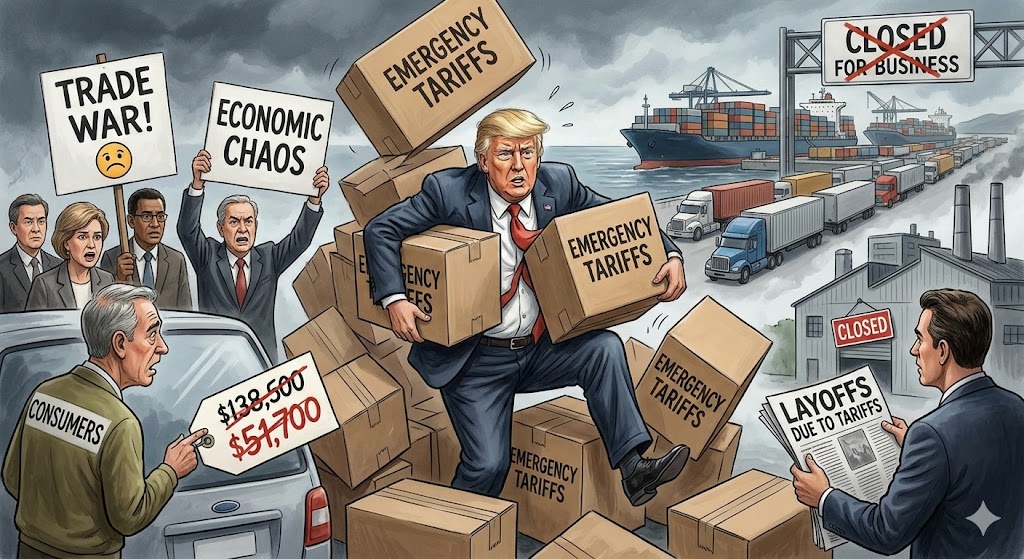
The IEEPA tariff journey did not end well. It turned out to be an illegal tax based on flawed economic principles, was reluctantly revoked under belated legal pressure, and compensated those who were said to be the object of "punishment."  The insistence on seeking punishment through other legal means risks extending the fiasco, keeping uncertainty high along the way.

Continue ReadingThe fiasco of Mr. Trump’s emergency tariffs

The Multiple Frontlines of the U.S.-China Technological Rivalry

The U.S.–China technological rivalry has become a central axis of global economic and geopolitical competition. While the United States continues to lead in frontier innovation—most notably in advanced semiconductors and artificial intelligence (AI)—China has consolidated strengths in large-scale implementation, manufacturing capacity, and control over critical segments of global supply chains. These advantages are especially visible in clean energy technologies and in the processing and refinement of critical minerals and rare earths. The rivalry now unfolds across multiple frontlines, extending beyond innovation itself to encompass infrastructure, energy availability, and technology deployment across the New South. Its outcome will depend less on breakthrough inventions alone than on each country’s capacity to integrate technology, industrial policy, and energy systems into cohesive national strategies.

Continue ReadingThe Multiple Frontlines of the U.S.-China Technological Rivalry

The Silent Majority of the New South: Small States, Davos 2026, and the Last Line of International Law

This article examines the quiet but profound implications of the erosion of U.S.-led hegemony for small and vulnerable states of the New South. While the post-1945 international order was never egalitarian, it offered predictability: power was organized through law, and sovereignty for weaker states rested less on justice than on procedural stability. Davos 2026 marked a turning point in the public acknowledgment of that system’s unraveling. Statements by leading Western figures revealed not a revolt against American power, but a growing recognition that the United States is increasingly retreating from the obligations that once distinguished hegemony from dominance. As rules give way to discretion, and institutions to transactional bargaining, the capacity of states to navigate global disorder is becoming sharply unequal. The article argues that this shift is existential for small states—particularly in the Middle East and North Africa—whose sovereignty depends almost entirely on international law and multilateral institutions. Unlike middle powers, they lack buffers, leverage, and visibility; their vulnerability rarely translates into voice. Climate change, debt distress, and security dependence deepen this asymmetry, making legal obligation—not power—their primary shield. Far from idealism, international law functions for these states as the infrastructure of survival. The weakening or bypassing of multilateral rules thus constitutes a systemic stress test: not of global morality, but of global stability. If the last line of international law collapses, the resulting order will not be more realistic—it will be more coercive, exclusionary, and ultimately less durable.
Continue ReadingThe Silent Majority of the New South: Small States, Davos 2026, and the Last Line of International Law

The global economy is on a two-way track

Global economic growth has been more resilient than expected, as the artificial intelligence-led growth seems to be compensating for the negative impacts of trade conflicts. Overstretched asset values and slowing jobs growth may be signaling that the balanced crossing of those two paths will be challenged.

Continue ReadingThe global economy is on a two-way track

Growth Implications of a Fractured Trading System

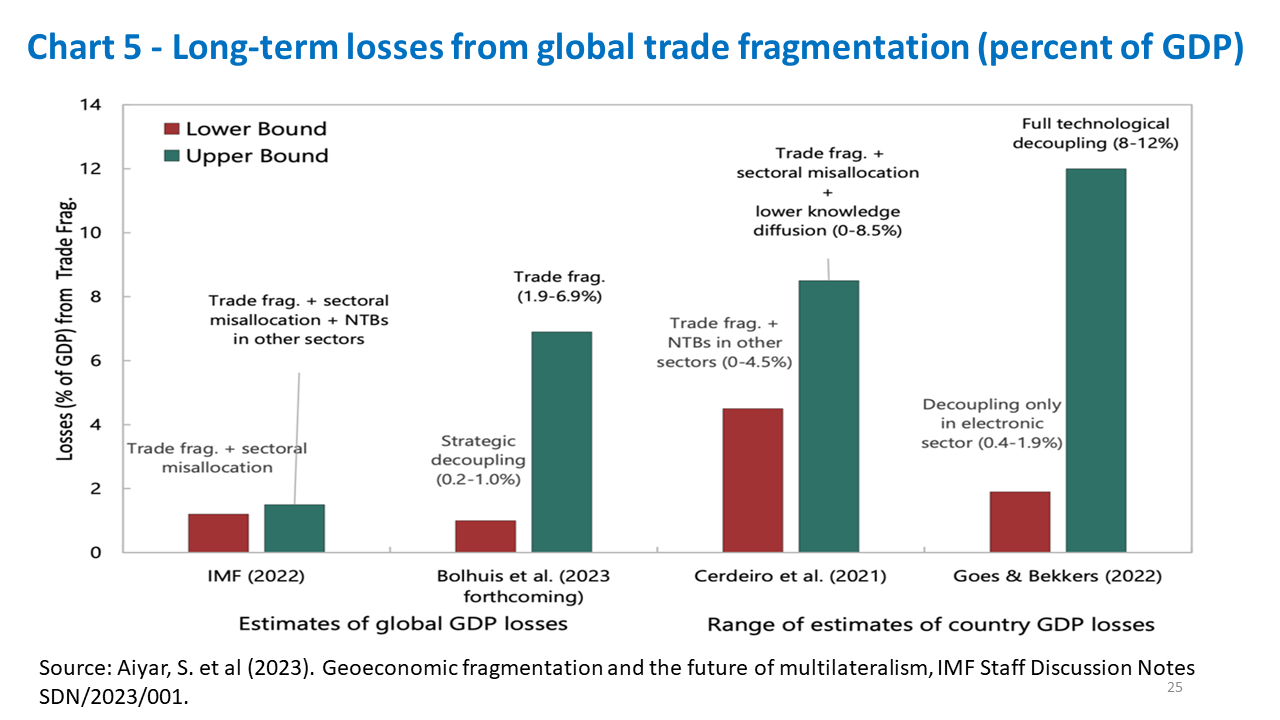
- The costs are greater the deeper the trade fragmentation. - Reduced knowledge diffusion due to technological decoupling is a powerful negative amplifier of the trade channel. - Emerging markets and low-income countries are most at risk from trade and technology fragmentation. - Transition costs can be considerable, in some cases even exceeding the final trading impact. - The estimates provided are not the upper bound. The G20 might not address issues of national security directly, but there's much they can do, especially regarding the trade-offs between resilience and efficiency, designing policies to avoid resorting to the least discretionary breadth.

Continue ReadingGrowth Implications of a Fractured Trading System

The Rich World’s Immigration Conundrum

Fourteen high-income countries have shown how immigration can help offset declining fertility rates and maintain population levels. But with anti-immigrant sentiment on the rise, politicians in these countries face a difficult choice: welcoming foreigners or facing the economic challenges brought about by an aging population.

Continue ReadingThe Rich World’s Immigration Conundrum

The Global War of Subsidies

Janet Yellen warns China against flooding the world with cheap exports of clean energy. Excess industrial capacity and government support in China's clean energy sector were discussed by US Treasury officials. The US, EU, South Korea, Japan, and Australia are implementing subsidy programs to protect their domestic industries and compete with China.

Continue ReadingThe Global War of Subsidies

Demographic Dynamics and Immigration Policies in High-Income Countries

Most high-income countries will experience declines in their populations over the next few decades. Some negative consequences of aging are on the horizon: greater fiscal imbalances and risks of economic stagnation. Immigration may be a way for those countries to mitigate the tendency. On the source side of immigration flows, brain drain is a risk. The policy paper presents the case of Japan, a nation that has grappled with the consequences of a declining and aging population for several years, as an example for other countries destined to confront similar circumstances in the forthcoming decades.

Continue ReadingDemographic Dynamics and Immigration Policies in High-Income Countries

Emerging Markets and Developing Economies in the Global Financial Safety Net

When countries face external financial shocks, they must rely on financial buffers to counter such shocks. The global financial safety net is the set of institutions and arrangements that provide lines of defense for economies against such shocks. From any individual country standpoint, there are three lines of defense in their external financial safety nets: international reserves, pooled resources (swap lines and plurilateral financing arrangements), and the International Monetary Fund. We argue here that there is a need to extend and facilitate access to the ultimate global financial safety net layer: the IMF. We illustrate that by pointing out how Morocco and Mexico have boosted their defensive power by having access to IMF precautionary lines of credit.

Continue ReadingEmerging Markets and Developing Economies in the Global Financial Safety Net

The global economy faces a lost decade

The economic factors that have propelled global prosperity over the past three decades are losing their grip. The aging and slow growth of the global workforce are highlighted as downward factors, explaining half of the expected slowdown in potential GDP growth through 2030. What should countries do in the face of this prospect of a “lost decade”?

Continue ReadingThe global economy faces a lost decade

Whither the Phillips Curve?

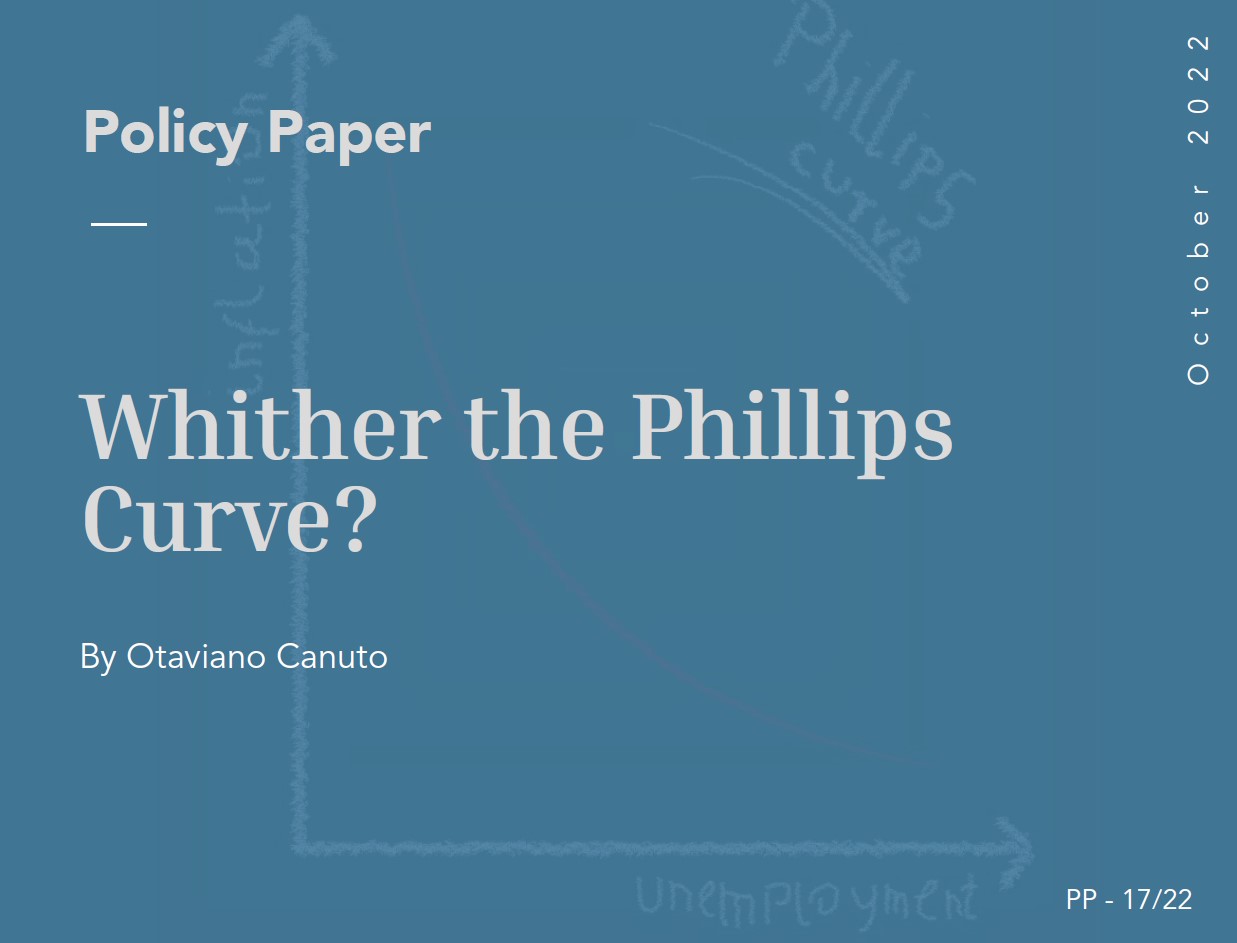
There is an international movement to tighten monetary and fiscal policies as a response to the global inflation phenomenon. Accordingly, global economic growth projections for 2022 and 2023 have been revised downward. As inflation will decline only gradually, given the price stickiness of its core components, there is likely to be momentarily a situation of stagflation, i.e. a combination of significant inflation and low or negative GDP growth. We discuss how the current global stagflation experience might develop into one of a soft landing, a sharp downturn, or a deep recession. The evolution will depend on how fast inflation responds downward to economic deceleration. We therefore suggest framing the response in terms of assessing to where major economies’ Phillips curves have shifted. Phillips-curve shifts will also reflect cross-border repercussions of country-specific policy choices. Furthermore, sudden abrupt deteriorations of financial conditions may cause additional moves in Phillips curves.

Continue ReadingWhither the Phillips Curve?

Dollar dominance will remain

The heavy financial sanctions on Russia after the invasion of Ukraine sparked speculations that the weaponization of access to reserves in dollars, euros, pounds, and yen would spark a division in the international monetary order. There has been a reduction in the degree of "dollar dominance” with the dollar's share of central bank reserves falling since the beginning of the century. The relative dominance of the dollar appears to be declining but at a very gradual pace.

Continue ReadingDollar dominance will remain

War in Ukraine and Risks of Stagflation

The war in Ukraine is bringing substantial financial, commodity price, and supply chain shocks to the global economy. Sanctions on Russia are already having a significant impact on its financial system and its economy. Price shocks will have a global impact. Energy and commodity prices—including wheat and other grains—have risen, intensifying inflationary pressures from supply chain disruptions and the recovery from the pandemic. The push toward relative deglobalization received from the pandemic will get stronger. One may expect an increasing weight of geopolitics in international payments and in the access to special commodities.

Continue ReadingWar in Ukraine and Risks of Stagflation

Will Emerging Economies Face a Hard Landing?

Is the growth slowdown with tightening financial conditions in advanced economies likely to be disastrous for emerging markets, with landing becoming a hard one in their case? If inflation moderates in the United States, due to reduced fiscal stimulus and fading supply chain restrictions, while growth remains minimally robust, emerging markets could avoid a hard landing. Several factors favor such a scenario.

Continue ReadingWill Emerging Economies Face a Hard Landing?