
Financial Times – Brazil’s electoral race no dog and pony show
Joe Leahy SEPTEMBER 5, 2014 When Brazil’s presidential election circus arrived in Rio Grande do Sul this week, it was hard not to see the difference between the styles of…

Joe Leahy SEPTEMBER 5, 2014 When Brazil’s presidential election circus arrived in Rio Grande do Sul this week, it was hard not to see the difference between the styles of…

This paper studies the growth effects of externalities associated with intergenerational health transmission, health persistence, and access to infrastructure (or lack thereof), which affects women's occupational choices. Following a brief review of the evidence on these issues, a gender-based overlapping generations (OLG) model of endogenous growth that captures these interactions is presented and its properties characterized. The endogeneity of mothers’ rearing time and rearing costs implies that improved access to infrastructure has in general an ambiguous effect on growth. Numerical experiments, based on a calibrated version of the model for low-income countries, show that it is possible for higher investment in infrastructure to actually reduce the steady-state growth rate. The possibility of multiple equilibria induced by an endogenous survival rate is also discussed, and so is the role of public policy in that context.

Capital Finance International, summer 2014 Some analysts have predicted that the commodity price boom has played itself out. However, natural resource-based commodity prices (with the exception of shale gas…
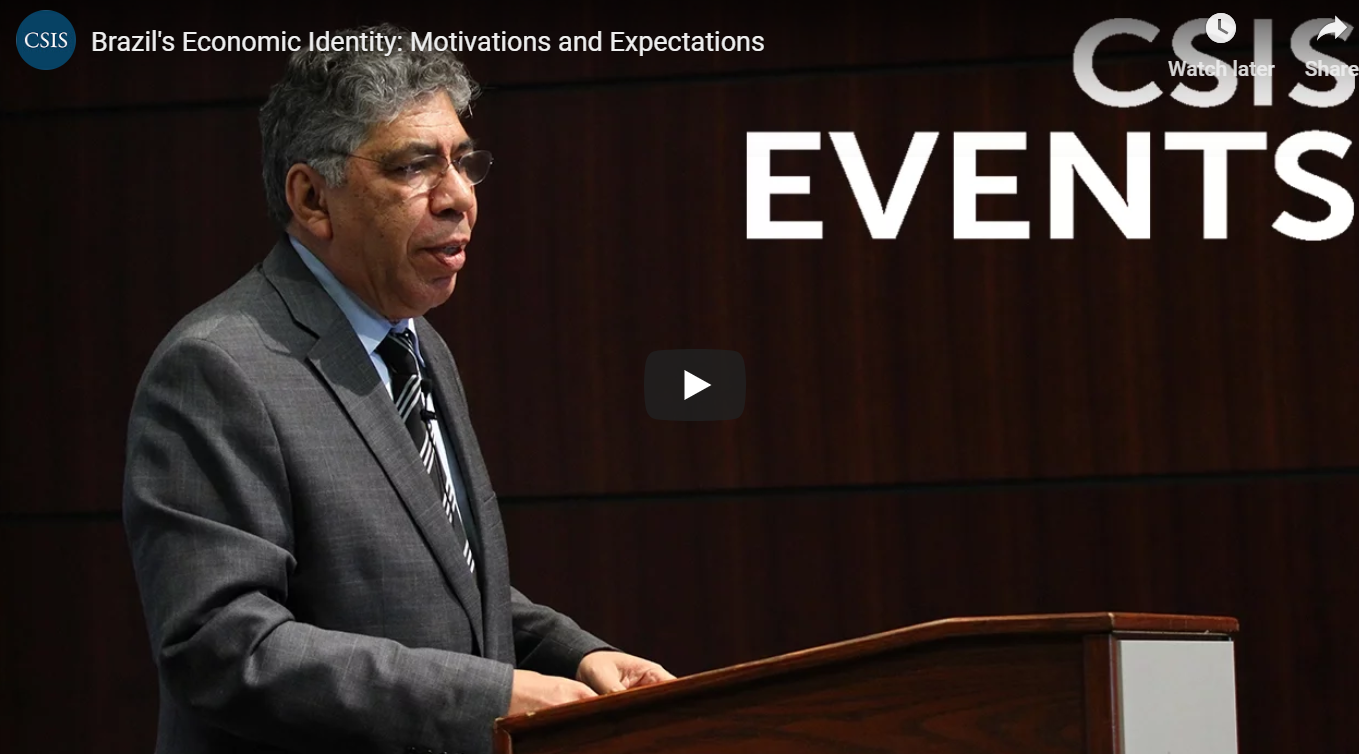
Brazil's Economic Identity: Motivations and Expectations Center for Strategic & International Studies Published on Jul 17, 2014 Featured Remarks by: Otaviano Canuto Senior Advisor on the BRICS Economies Development Economics…

It has become increasingly evident over the last two years that the growth engine of the Brazilian economy has run out of steam. Despite relative resilience during the global…

Valor Econȏmico - 15 maio 2014 Brasil tem vulnerabilidades internas, diz Blanchard Por Sergio Lamucci | De Nova York Para o economista-chefe do FMI, investidores ainda estão preocupados com…

Policy makers in the advanced economies at the core of the global financial crisis can make the claim that they prevented a new “Great Depression”. However, recovery since the outbreak of the crisis more than five years ago has been sluggish and feeble. Since these macroeconomic outcomes have to some extent been shaped by policy mixes adopted in those economies in response to the crisis, the appropriateness of those policy choices is a question worth revisiting. This is particularly the case as one considers the hypothesis that a long-run trend toward stagnation may have already been at play during the pre-crisis period, even if temporarily countervailed by pervasive asset price booms.

In the aftermath of the recent global financial crisis, advanced economies have continued to experience sluggish growth. Is this slow postcrisis growth the result of a policy response that was overly reliant on monetary policy, which ran into the zero interest rate lower bound before growth was restored? Looking deeper, is secular stagnation, which is related to the zero lower bound and was recently brought to the fore by Larry Summers, another potential cause for advanced economies’ failure to return to precrisis growth levels? This note seeks to answer these questions as well as identify what alternative policies might be pursued by advanced economies to escape secular stagnation, should stagnation proponents be proven correct. After a brief review of secular stagnation, Summers’ hypothesis is tested through a review of academic literature and opinion pieces. However, the secular stagnation theory is not without its critics; moreover, there is a debate between “Keynesian versus Schumpeterian” economists, which could help to shed light on the medium-term postcrisis outlook.

IÉSEG - Dr. Otaviano Canuto on emerging markets in the global economy IÉSEG School of Management Published on Mar 17, 2014 Otaviano Canuto who is the Senior Adviser on BRICS…

There is a core divergence among some “Keynesian” and “Schumpeterian” economists who have proposed such stagnation hypotheses; each camp points to different underlying factors for continued anemic levels of growth. “Keynesians” argue from the demand side, and believe that proactive fiscal policies are needed for a strong recovery, while “Schumpeterians” believe that the necessary force of creative destruction has continually been stymied by such policies.

Countercyclical moves by policy makers might have reduced the length and size of the observed output gap had fiscal policy operated as a countercyclical tool complementary to monetary policy. Regardless of whether restrictive fiscal policies have been a necessity or an option, the fact is that they have constituted a major factor leading to a subpar recovery performance.
After experiencing an initial period of rapid growth, many developing countries have fallen into the middle-income “trap”—stuck between low-wage, low-technology markets and high-income, innovation-based developed economies. This note argues that inadequate access to finance has an adverse effect on innovation, directly, through the financing of fewer research and development (R&D) projects, and also indirectly, as fewer individuals may choose to invest in the skills necessary to work in R&D fields.

Está na hora de desentupir as artérias do transporte urbano hoje para evitar o derrame e a paralisia amanhã. São Paulo e Mumbai são ambas megarregiões metropolitanas com cerca…

O Brasil tem um longo caminho pela frente. Para começar, os investimentos anêmicos em infraestrutura tradicional desde os anos 80 tornaram-se um forte freio à PTF, contribuindo para o desperdício e ineficiência dos atuais sistemas de produção. Isso poderia ser resolvido com um ajuste fino da divisão de trabalho, entre os setores público e privado, nos investimentos e na administração da infraestrutura, com a meta de arregimentar mais capitais privados. Certamente, o Brasil também deveria resolver a questão do valor agregado que afeta todas as economias de renda média, o que implica a necessidade de melhorar o cenário operacional do setor privado. Da forma como está, aspectos fundamentais desse cenário - como as complicadas exigências burocráticas e o excesso de horas de trabalho necessárias para pagar impostos - tornam o custo de se fazer negócios no Brasil incompatível com cadeias de produção complexas, além de corroer a produtividade, por desperdiçar recursos materiais e humanos. Por fim, para ajudar a melhorar a prestação de serviços, o Brasil deveria lançar uma revisão ampla dos gastos públicos. Os gastos públicos que vão além daqueles necessários para as funções básicas do governo comprometem uma parte importante do PIB do Brasil. Cortar os gastos que não são voltados à eliminação da exclusão e das armadilhas ao crescimento da infraestrutura permitiria ao governo elevar os investimentos nas áreas mais necessárias ou reduzir encargos tributários do setor privado.