The fiasco of Mr. Trump’s emergency tariffs

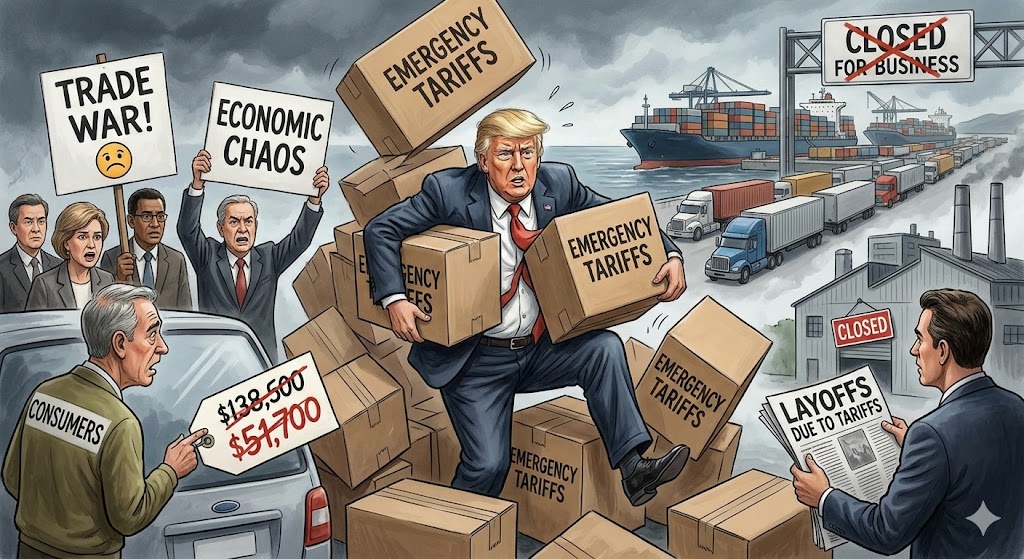
The IEEPA tariff journey did not end well. It turned out to be an illegal tax based on flawed economic principles, was reluctantly revoked under belated legal pressure, and compensated those who were said to be the object of "punishment."  The insistence on seeking punishment through other legal means risks extending the fiasco, keeping uncertainty high along the way.

Continue ReadingThe fiasco of Mr. Trump’s emergency tariffs

The American Industrial Transformation: Beyond the Deindustrialization Myth

What the U.S. has lost in domestic manufacturing, it may have gained in global productive presence. Understanding the transformation of U.S. manufacturing requires an assessment of the revolutionary impact of technology. Tomorrow’s industrial jobs require completely different qualifications from yesterday’s, and even successful production reshoring wouldn't necessarily restore the industrial employment levels of previous decades. Some confusion about U.S. ‘deindustrialization’ also arises from how sectoral GDP is measured. A significant share of value added in industrial production, especially high-value activities, is classified as ‘services’. The deindustrialization narrative, and the political platform of ‘Make America Great Again’ by reindustrializing it, reflects an identification between the evolution of U.S. manufacturing during globalization and the unequal appropriation of economic gains by the top of the income pyramid. The real strategic question for the U.S. isn't how to compete with China in low value-added goods production, but how to maintain and expand its leadership in high-tech segments, design, innovation, and global value chain coordination.

Continue ReadingThe American Industrial Transformation: Beyond the Deindustrialization Myth

The global economy is on a two-way track

Global economic growth has been more resilient than expected, as the artificial intelligence-led growth seems to be compensating for the negative impacts of trade conflicts. Overstretched asset values and slowing jobs growth may be signaling that the balanced crossing of those two paths will be challenged.

Continue ReadingThe global economy is on a two-way track

The U.S. Tariff Saga Hasn’t Reached Its Climax Yet

The Trump tariff saga hasn't reached its climax yet, but a shift in import sources is evident. Regarding the trade balance, everything will depend on the continuation of the boom driven by high-tech investment. The harmful effects of tariffs on the rest of the economy will take time to unfold.

Continue ReadingThe U.S. Tariff Saga Hasn’t Reached Its Climax Yet

Brazil As a Special Target of President Trump’s Tariff Hikes

The costs of Brazilian tariff retaliation would likely be high for its economy, because of risks of even higher U.S. tariffs and because of Brazil’s domestic use of current imports from the U.S. At the same time, it is unimaginable that Brazil will fall into the trap of accepting a ‘political’ negotiation plan. Brazil will have to count on some eventual support from U.S. domestic opponents of the tariffs, in addition to any other trade matters that may come up in bilateral conversations between Lula and Trump that may take place in the near future. Beyond that, Brazil will just have to bite the bullet.

Continue ReadingBrazil As a Special Target of President Trump’s Tariff Hikes

Asian Economic Integration Led by Trade Liberalization: A Lesson for Other Regions

Developing countries have few options to deal with the ongoing tariff war amid unpredictable shifts in global supply chains. However, regional economic integration offers a strategic path of development in these uncertain and challenging times. Helped by geographical proximity and cultural familiarity, countries in a region can benefit greatly from promoting trade with one another, reaping the benefits of comparative advantages and economies of scale—if they are able to establish a large enough single market. Asia has successfully used regional cooperation and integration as stepping stones in its interactions with the rest of the world during the course of its economic development. Asia can thus offer lessons that other regions—especially Africa and Latin America—can benefit from.

Continue ReadingAsian Economic Integration Led by Trade Liberalization: A Lesson for Other Regions

The Global Impact of President Trump’s Reciprocal Tariffs: Implications for Developing Countries

President Donald Trump's "Reciprocal Tariff" policy, announced on April 2, 2025 (dubbed "Liberation Day"), represents one of the most significant shifts in U.S. trade policy in nearly a century. Trump’s policy imposes a baseline 10% tariff on all imports and additional country-specific tariffs that range from 10% to 50% for countries designated as having "non-reciprocal trading practices" with the U.S. These specific tariffs are determined based on each country’s bilateral trade balance with the U.S. Postponements and bilateral trade negotiations started after April 9, 2025. This paper develops a two-country general equilibrium model to analyze the economic implications of the originally announced “Reciprocal Tariff” policy, with particular emphasis on developing countries. Initially characterized by a trade deficit in the U.S. and asymmetric tariff structures, the model explores the effects of the U.S. unilaterally raising its tariffs to match those of its trading partners. We incorporate comparative advantage (CA), sectoral heterogeneity, and the interaction of tariff policy with monetary policy. The results suggest that while tariff equalization can reduce trade imbalances and improve U.S. terms of trade, it generates efficiency losses and results in ambiguous welfare outcomes. A calibrated policy mix is required to balance trade, inflation, growth, and equity objectives. While the administration framed these tariff reciprocal measures as essential for addressing trade imbalances and strengthening American manufacturing, our analysis identifies significant economic repercussions for developing economies. Key findings include the disproportionate impact on developing nations with export-oriented growth strategies, disruption of global value chains, potential reversal of development gains, and acute vulnerability for many African and Asian nations that face some of the highest tariff rates. The policy would likely trigger structural economic changes in the global trading system, with implications that extend well beyond the immediate tariff impacts.

Continue ReadingThe Global Impact of President Trump’s Reciprocal Tariffs: Implications for Developing Countries

Growth Implications of a Fractured Trading System

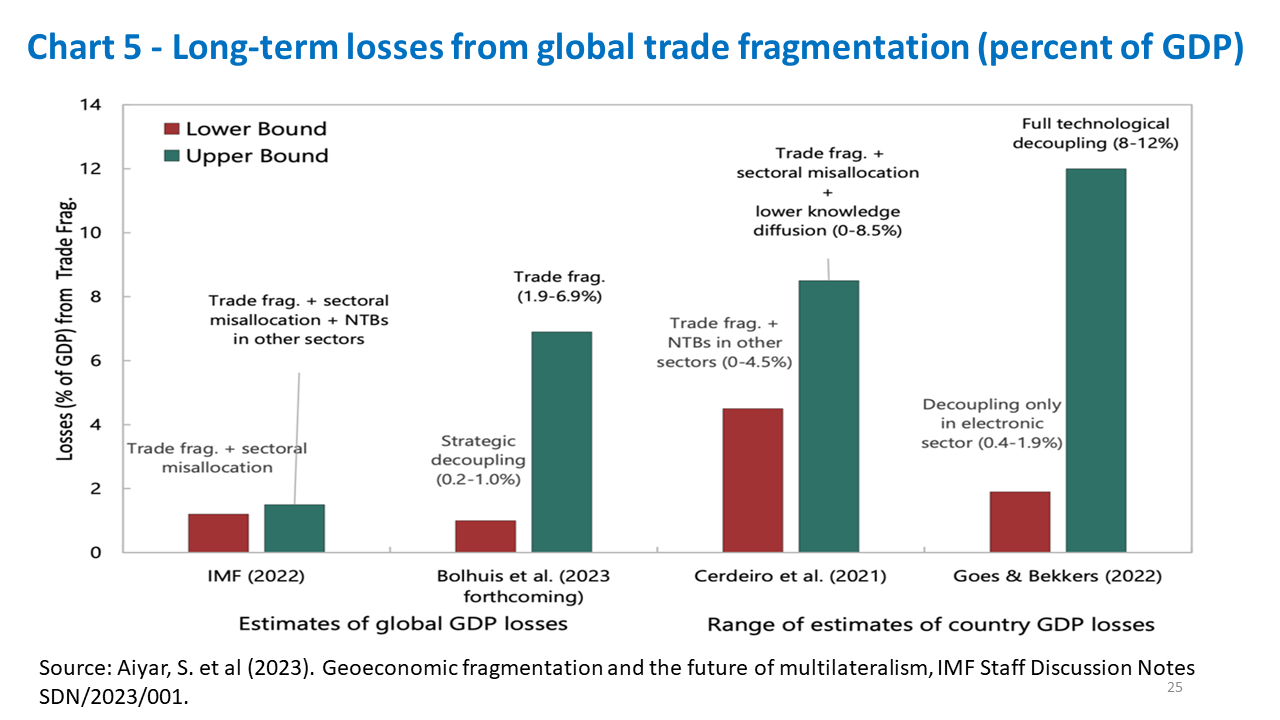
- The costs are greater the deeper the trade fragmentation. - Reduced knowledge diffusion due to technological decoupling is a powerful negative amplifier of the trade channel. - Emerging markets and low-income countries are most at risk from trade and technology fragmentation. - Transition costs can be considerable, in some cases even exceeding the final trading impact. - The estimates provided are not the upper bound. The G20 might not address issues of national security directly, but there's much they can do, especially regarding the trade-offs between resilience and efficiency, designing policies to avoid resorting to the least discretionary breadth.

Continue ReadingGrowth Implications of a Fractured Trading System

The Spring of Tariff Regret

The IMF has reviewed the global growth downward, highlighting the impacts of Trump's tariff war and warning about financial and economic risks. Although the negative effects of tariffs have already been “somewhat priced in,” according to Tobias Adrian (IMF), equity and bond prices could “certainly” fall further if negotiations fail. So, it’s either successful negotiations or further stress and downgrades.

Continue ReadingThe Spring of Tariff Regret

The Automotive Transition on the Road to Decarbonization

The road to decarbonizing the planet runs through the energy transition, which includes the shift from fossil-fueled cars to renewable energy vehicles. This automotive transition is unfolding as a true revolution in the industry. The evolution toward electric and hybrid vehicles has come in tandem with the ascent of Chinese producers. In the current context of geopolitical and technological rivalries, the automotive transition has been marked by an intense trade war, with implications for the trajectory of decarbonization.

Continue ReadingThe Automotive Transition on the Road to Decarbonization

Pathways for Reconciling New Industrial Policy and International Cooperation for Global Goods

The resurgence of Neo protectionism as a reality is creating a pressing need to establish New Industrial Policies (NIPs) capable of striking a balance between Global Value Chains (GVC) managers' quest for efficiency and policy makers' need for more increasing resilience or national security in a turmoiled geopolitical landscape. Furthermore, although NIPs might pursue legitimate non-economic objectives, they are often captured by vested interests, resulting in protectionist measures. These policies produce negative spillovers, jeopardizing other countries’ development perspectives. This policy brief posits that countries embracing industrial policies with trade diversion components must allocate efforts to implement additional trade liberalization in sectors where the affected exporting countries have comparative advantages as compensation for the negative spillovers their unilateral domestic policies impose on third countries. This highlights the need to establish a structured system that penalizes protectionist countries for exceeding predetermined limits on subsidies and distortive measures. This policy brief also recommends that advanced economies implementing industrial policies with high amounts of embodied subsidies contribute to an international fund dedicated to financing developing economies' access to new green technologies. This approach acknowledges the undeniable push towards aggressive industrial policies, yet simultaneously strives to establish a framework to temper this emerging trend. This mechanism aligns with the principles of economic fairness and encourages nations to adopt less distortive behaviors in their pursuit of economic security or resilience to shocks.

Continue ReadingPathways for Reconciling New Industrial Policy and International Cooperation for Global Goods

Resilience and Realignment of Global Trade

Multiple shocks faced by the global economy over the past three years have apparently shaken the conventional wisdom on gains from economic integration, and have sparked widespread calls for protectionist and nationalist policies. Is there already evidence of some ‘deglobalization’, or do the factors that underlie globalization remain strong enough despite the shocks? So far, there are no signs of an overall reversal in the long-term trend of greater global trade integration. However, a partial realignment seems to be underway, reflecting the more durable side of those recent shocks. This is probably leading to higher costs and prices on the margin, in the case of realignments done to overcome shocks of a geopolitical nature. The answer seems to be that global trade has been resilient, although it is undergoing some realignment.

Continue ReadingResilience and Realignment of Global Trade

Growth Implications of a Fractured Trading System

An assessment of the implications for growth—particularly the costs—of moving towards a fractured trading system can use as a benchmark what happened during the period of what is usually called hyper-globalization or globalization 2.0 Substantial growth in GDP per capita in emerging markets and developing economies, as well as reductions in poverty rates and lower per capita GDP inequality among countries were major achievements. The transmission channels of the trade fragmentation will be a reversal of the path by which those gains were attained.

Continue ReadingGrowth Implications of a Fractured Trading System