
THE JOURNAL OF TECHNOLOGY TRANSFER August 2025
Sergio Queiroz, Nicholas Vonortas, Otaviano Canuto
1 Introduction
Over the past two decades, Brazil has significantly expanded its R&D funding and incentive instruments. Despite this, business sector R&D spending has remained stubbornly low and stagnant. In parallel, the country’s innovation and economic performance throughout the twenty-first century has been underwhelming.
Brazil transitioned from a period of extraordinary economic performance for much of the twentieth century to a pattern of mediocre growth since the 1980s. This shift has positioned the country as a textbook case of the “middle-income trap” (MIT), as this paper will demonstrate. Given that the set of countries falling into the MIT category is quite large, one could reasonably advocate that the challenges elucidated herein resonate the conditions and tendencies in other emerging economies. Nonetheless, some of these countries with potentially large internal markets have tried to address them earlier and perhaps more successfully (e.g., India).
Why, after years of government initiatives to promote R&D and innovation, have public policies proven so ineffective? Why, despite progress in several areas—such as nurturing regional entrepreneurial ecosystems, efforts to bring research universities closer to industry, and successful programs to address the “valley of death” in some states—is the country as a whole still unable to break free from the low-growth gap? These are the central questions this paper seeks to address.
There is a broad but inconclusive debate regarding the causes of Brazil’s relative economic stagnation over the past four decades. A wide range of explanations has been offered, from macroeconomic instability and the role of the state to factors such as low investment in education and failures in technology transfer. However, in our view, this debate has yet to converge on a clear diagnosis or yield a coherent public policy agenda. Some critical elements remain overlooked.
We argue that significant global changes since the 1980s have shaped Brazil’s current economic challenges in ways that have not been adequately appreciated by policy decision makers. Globalization and the rise of global value chains (GVCs) are key. We seek to demonstrate how such international shifts, combined with enduring domestic issues, disrupted the trajectory of industrial and technological development that Brazil had followed since the 1930s. In essence, growth strategies that relied on the scale of the domestic market ceased to be effective. The innovation and economic challenges the country now faces cannot be resolved without a proper understanding of these evolving dynamics.
The analysis leads to specific policy implications, centered on the need for less protectionism and greater international integration of Brazilian firms. Reversing the inward-looking orientation of Brazil’s industrial sector is essential for any policy aimed at increasing business R&D and fostering innovation, a conclusion that may be extended to other emerging economies with limited competition in their economic environment, particularly in Latin America.
The rest of the paper is structured into six sections. The next section briefly reviews Brazil’s innovation performance in recent times. The third section discusses the country’s current position in the so-called MIT. The fourth section explores global transformations that are often underestimated in analyses of Brazil’s innovation and economic underperformance. The fifth section presents an alternative explanation that integrates these international developments. The sixth section outlines a policy agenda aligned with the goal of overcoming the MIT. Finally, the seventh section concludes.
2 The innovation failure in Brazil
Since the late 1990s, science and technology policy in Brazil has made innovation a central priority. Beginning with the creation of the Sectoral Funds in 1999, followed by subsidy schemes and fiscal incentives to promote business R&D—such as the Green and Yellow Fund (2001), the Innovation Law (2004), and the Lei do Bem (2005)—there has been a significant expansion in the number of instruments aimed at fostering innovation (IEDI, 2010).
More recently, initiatives at both the federal and state levels, including programs by the Research Foundation of the State of São Paulo (FAPESP) to support innovation-driven research, have reinforced this policy agenda. Overall, public policy in Brazil has consistently embraced the objective of stimulating innovation.
Despite these efforts, the outcomes have been disappointing. As shown in Table 1, and based on information from the Brazilian business innovation survey (PINTEC), there is little evidence to suggest that Brazilian firms are improving their innovation performance.
Table 1 Percentage of companies that implemented product and/or process innovation. Source: PINTEC—IBGE

In addition, the subsidies and fiscal incentives intended to promote R&D do not appear to be effective. Figure 1 highlights the stark contrast between Brazil and two rapidly advancing technology economies: China and South Korea. At the beginning of the century, China’s R&D expenditure as a percentage of GDP was lower than Brazil’s. However, while Brazil’s innovation effort has remained stagnant, China has rapidly increased its investment and is now approaching the levels seen in OECD countries for this indicator (Canuto, 2011, ch. 11).
Fig. 1
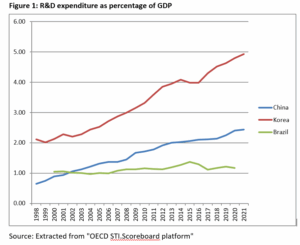
R&D expenditure as percentage of GDP. Source: Extracted from “OECD STI Scoreboard platform”
A closer look at the indicator in Fig. 2 reveals two noteworthy points. First, as previously mentioned, R&D expenditure in Brazil has remained stagnant over the past two decades. The apparent peak in 2015 is misleading—it reflects a drop in GDP due to the recession at the time, rather than an actual increase in R&D spending.
Fig. 2
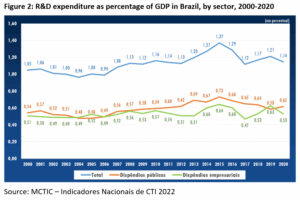
R&D expenditure as percentage of GDP in Brazil, by sector, 2000–2020. Source: MCTIC – Indicadores Nacionais de CTI, 2022
Second, public R&D expenditure slightly exceeds business spending. Government investment—around 0.65% of GDP—is relatively robust and aligns with the average observed among OECD countries (0.67% for the 2015–2020 period). In contrast, business R&D expenditure in Brazil, at approximately 0.6% of GDP, falls significantly short of the OECD average of 1.83% over the same period.
The obvious question that arises is: why do companies in Brazil invest so little in R&D? Why, despite all the government measures to incentivize business R&D, has there been so little progress?
Two respected analysts of science and technology policy in Brazil have posed similar questions (Pacheco & De Negri, 2022): why are public policies unable to motivate companies to invest more in technology and innovation? Why, after years of prioritizing innovation in public discourse, have the results been so limited? And why, unlike in many other countries, does private sector investment account for less than 50% of total R&D expenditure in Brazil?
They acknowledge that something is clearly not working—and emphasize that it is time to understand why and how to fix it. To begin addressing these questions, we may need to rethink the focus of policy. Thus far, efforts have leaned heavily on the supply side—emphasizing measures to induce firms to invest in R&D. The demand side—creating conditions that make firms want to invest in R&D—has been neglected. As the old saying goes, you can lead a horse to water, but you can’t make it drink.
Since innovation is a major driver of economic growth, stronger engagement by companies in innovation is essential for boosting productivity and long-term economic performance. Economic growth depends on increases in total factor productivity (TFP) alongside capital accumulation. In turn, TFP gains reflect not only greater efficiency in resource allocation but also the accumulation and application of technological capabilities to innovate (Canuto, 2021). Technological learning—using, adapting, and innovating—is essential. R&D serves as a crucial input for innovation and, by extension, economic growth.
Thus, business R&D is part of the solution to the longstanding challenge that has plagued the Brazilian economy since the 1980s: its relatively weak macroeconomic performance. Four decades of sluggish economic growth have created a vicious circle: a poorly performing economy discourages R&D investment and, in turn, hampers innovation and growth.
It is therefore useful to take a step back to gain a clearer picture of Brazil’s economic performance in the recent decades.
3 The Brazilian “middle-income trap”
Brazil had an impressive economic development from the end of WWII until the 1980s. Figure 3 provides an overview of Brazil’s economic development during the twentieth century and the two first decades of the 21st. As shown, from 1945 to 1980, Brazil’s per capita GDP relative to that of the U.S. rose from 11 to 28%. The setbacks of the following two decades seemed to be overcome in the 2000s, but we saw a reversal once again in the 2010s. The country now appears stuck at around 25% of the U.S. per capita GDP.
Fig. 3
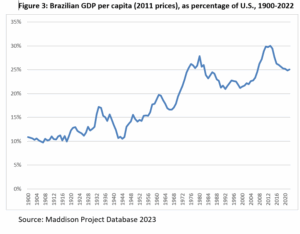
Brazilian GDP per capita (2011 prices), as percentage of U.S., 1900–2022. Source: Maddison Project Database 2023
For a more focused view of recent times, Fig. 4 compares the evolution of Brazil’s GNI per capita with that of East Asia and Pacific countries and other upper-middle-income countries since 1989. After an exuberant performance during the first decade of the century, Brazil’s GNI per capita has even declined in recent years.
Fig. 4
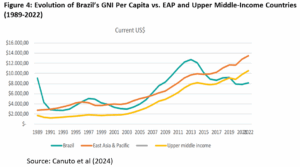
Evolution of Brazil’s GNI Per Capita vs. EAP and Upper Middle-Income Countries (1989–2022). Source: Canuto et al (2024)
According to Ipea data, between 1940 and 1980, Brazil’s average annual real GDP growth at market prices was 7.0%. In the following forty years, up to 2020, this rate fell to just 2.0%.
It is easy to understand how the industrialization process that began in the 1930s fueled rapid economic growth in the subsequent decades. It triggered a structural shift in the composition of output—less agriculture and more manufacturing—while boosting overall productivity and accelerating economic growth. This is a well-known trajectory for economies transitioning from low to middle-income levels.
Technological development during this phase did not face major challenges. Imported technology—via machinery, services, and technology transfer contracts—was largely sufficient to meet the requirements of the manufacturing sector. The technology generated locally throughout the industrialization period was adaptive in nature, building on technologies already well established in advanced countries (Katz, 1987).
The abrupt slowdown in the 1980s clearly indicates the exhaustion of the import-substitution process and its failure to evolve toward more sophisticated levels of technological capability in process engineering, product engineering, and R&D within the manufacturing sector. The transition required moving from know-how capabilities to know-why capabilities, as Lall (1982) put it—or, in more contemporary terms, a leap from implementation to design capabilities (Lee et al., 2021), from imitation to innovation (Agénor & Dinh, 2013), and toward the development of a knowledge-based economy (Lee, 2013).
The sharp contrast in the economic performance of the Brazilian economy before and after 1980 has made the country a classic case of “MIT” (Canuto et al., 2024). The term “MIT” (MIT) broadly describes the experience of developing countries that successfully transitioned from low to middle levels of per capita income but then stalled, losing momentum on the path toward the higher income levels of advanced economies. This trap aptly characterizes much of Latin America’s experience since the 1980s and, in recent years, middle-income countries elsewhere have voiced concerns about following a similar trajectory. Underlying these concerns is a more general recognition: the climb up the income ladder becomes increasingly difficult the higher one goes (Canuto et al., 2020; Canuto, 2021). It also requires significantly different policy approaches as the nation shifts focus from imitation to innovation (Lee et al., 2021).
MIT refers to the need for policy and institutional changes that enable a country to continue climbing the income ladder after transitioning from low levels. Traps are seen as the result of shortcomings—specifically, the absence of the policy and institutional reforms deemed essential for advancing from middle- to upper-income status. In most historical cases of successful transitions from low- to middle-income per capita, the underlying development process has followed a broadly similar pattern. Typically, a large pool of unskilled labor is moved from subsistence-level occupations into more modern manufacturing or service activities that require little skill upgrading but employ higher levels of capital and embedded technology. This technology, usually sourced from richer countries, is being adapted to local conditions—as was the case in Brazil until the 1980s. The gross effect of this labor transfer—typically accompanied by urbanization—is a substantial rise in total factor productivity (TFP), meaning an expansion of GDP that exceeds what can be explained by increases in labor, capital and other physical production factors.
Reaping the gains from such “low-hanging fruit” in terms of growth opportunities eventually faces natural limits, after which growth slows and the economy risks becoming trapped at middle-income levels. The turning point in this transition typically occurs either when the pool of transferable unskilled labor is exhausted, or, in some cases, when the expansion of labor-absorbing modern activities reaches its peak before that exhaustion takes place.
Beyond this stage, raising total factor productivity and sustaining rapid growth becomes increasingly dependent on the economy’s ability to advance domestically—moving up the value chains in manufacturing, services, or agriculture into activities characterized by greater technological sophistication, alongside high demands for human capital and intangible assets such as design and organizational capabilities. Within-sector productivity gains and “moving up value chains” become more significant relative to the productivity gains from broad cross-sector structural change (Canuto et al., 2024). An institutional framework supportive of innovation and complex chains of market transactions is essential. Rather than simply mastering existing standardized technologies, the key challenge becomes building local capabilities and institutions—assets that cannot be imported or directly replicated from abroad. At a minimum, this requires providing quality education for the workforce and developing adequate infrastructure.
In Latin America, current middle-income countries experienced a slowdown in their labor-transfer processes from subsistence sectors before fully exhausting available labor surpluses. Macroeconomic mismanagement and inward-oriented policies until the 1990s imposed early limits on this transition. Nevertheless, some advanced enclaves along the value chain have emerged—for instance, Brazil’s technology-intensive agriculture sector, its sophisticated deep-sea oil drilling capabilities, its proficiency in aspects of pharmaceutical research (e.g., vaccines), extensive mining capabilities, and its expertise in aircraft design.
By contrast, Asian fast-growing economies have extensively leveraged international trade to accelerate labor transfers, primarily by integrating into the unskilled labor-intensive segments of GVCs. This strategy has been facilitated by advances in information and communication technologies, falling transport costs, and reduced international trade barriers. Together, these factors have enabled the fragmentation of production processes into chains of tasks with varying levels of sophistication, allowing geographically dispersed operations (Canuto, 2021).
Natural resource-rich middle-income countries face a distinct path. Unlike manufacturing, natural resource exploitation is largely idiosyncratic—each case shaped by its unique context. This creates significant opportunities for building local capabilities in sophisticated upstream and downstream activities, though doing so sustainably remains a critical challenge. Even in this context, an institutional framework that supports innovation, complex market transactions, advanced education, and the development of intangible assets remains indispensable.
The local development of capabilities for imitation and creative adaptation of existing technologies—followed by, or evolving alongside, innovation capabilities—is essential for raising productivity, upgrading employment, and moving up the income ladder. The effective application of technology requires locally embedded knowledge that cannot be fully acquired or transferred through textbooks or other codifiable means alone. This tacit knowledge is not easily made explicit, transmissible via blueprints, or perfectly diffused either as public information or private property; it must be cultivated locally. Production, technology adoption, and invention all require a relatively high level of such idiosyncratic knowledge and local capabilities.
While technology originators typically progress from invention to adoption and production, latecomer economies often follow the reverse path: beginning with production and technological adoption, and only later advancing to invention. This pattern has been evident in countries like South Korea and China (Canuto, 2021, ch.11), where innovation capabilities emerged after extensive learning through the use and adaptation of existing technologies.
However, mere interconnectedness within global systems does not automatically generate productivity gains or local innovation. Success hinges on a broad set of complementary factors, including access to finance, robust infrastructure, skilled labor, and strong managerial and organizational practices. In the absence of these conditions, investments in capability development are unlikely to yield substantial returns (Canuto et al., 2010; Cirera & Maloney, 2017).
To address a country’s challenges, solutions must target market failures that disincentivize knowledge accumulation. The interaction between the private and public sectors must not obstruct the increasing density and complexity of transaction chains that accompany progression. Transaction costs associated with “doing business”—such as trading across borders, hiring workers and enforcing contracts—must be kept manageable. Likewise, other dimensions of the “investment climate,” including policy uncertainty, macroeconomic instability, corruption, crime-related losses, and infrastructure quality, must be favorable to avoid discouraging investment in capability development (Canuto, 2019). Broadly speaking, the incentive structure for economic agents must favor the pursuit of efficiency over the extraction of economic rents (Canuto & Ribeiro dos Santos, 2018). Long-term success also requires institutional reform, high-level education, and the local development of intangible assets.
It is also important to note that, especially in large economies, heterogeneity and diversity are inevitable. Brazil’s upper-middle-income status, as classified by the World Bank, conceals a dual economic structure that encompasses both high- and low-income activities and jobs. Overcoming MIT in such a context means not only advancing high-value sectors but also upgrades a significant share of overall employment, particularly by lifting low-income segments that were left behind in earlier phases of development.
Traps may arise when upgrading becomes particularly difficult due to strong competition from incumbents in global markets. Gill and Kharas (2007) used the term “MIT” to describe economies that find themselves “squeezed between the low-wage poor-country competitors dominating mature industries and the rich-country innovators leading industries undergoing rapid technological change.” To a large extent, Latin America’s manufacturing sector was squeezed in this way by the significant influx of cheap labor into the global economy following the collapse of the Soviet Union and China’s integration into world markets.
Ultimately, however, the root causes of MITs often lie in local shortcomings—specifically, the inadequacy or absence of policies and institutions needed to support a successful upward transition. Agénor & Canuto (2015, 2017) developed analytical models showing how distorted incentives, talent misallocation, weak contract enforcement, insufficient intellectual property protection, limited advanced infrastructure, and restricted access to finance can trap a middle-income economy in a “bad” equilibrium characterized by low growth. Similarly, Aiyar et al. (2013) and Han and Wei (2017) highlight the negative growth effects of economies prone to frequent macroeconomic booms and busts.
In examining Brazil’s MIT, Canuto et al. (2024) analyze the country’s economic growth patterns over the past three decades, during which Brazil has experienced persistently low productivity growth and—apart from certain sectors—limited success in transforming its production and export structures toward higher value-added activities. In what follows, we discuss significant global changes in the recent decades that help explain the causes of Brazil’s MIT.
4 The underestimated effects of important changes in the world
Since the 1980s—a period known in Brazil as the “lost decade”—debate has continued over the root causes of the country’s sluggish economic performance. Why did Brazil experience such a sudden and prolonged loss of economic dynamism?
Various perspectives and explanations have been offered to answer that question. Lack of macroeconomic stability (Canuto et al., 2020), excessive state interference and public spending (Canuto & Cavallari, 2017; Mendes, 2022), insufficient accumulation of human capital (Barbosa Filho & Pessoa, 2013; Veloso et al., 2013) and dysfunctional institutions (Acemoglu & Robinson, 2012; Gonçalves (2013) are examples of structural and domestic problems that would undoubtedly hamper Brazil’s economic development. Each of these explanations contains elements of truth. However, none of these in isolation sufficiently explain the sudden change that occurred in the 1980s.
In this section, we introduce some external factors often overlooked in these analyses. Changes in the global economy—especially since the 1980s and 1990s—have significantly influenced Brazil’s economic conditions. We will focus on two specific external factors: globalization and the emergence of GVCs.
4.1 Globalization and the relevance of domestic markets
Globalization since the 1980s has unfolded across multiple dimensions. Among them, we can highlight the globalization of finance, production, and technology. Our focus here is on the globalization of firms and industries, with Foreign Direct Investment (FDI) serving as a key indicator of this process.
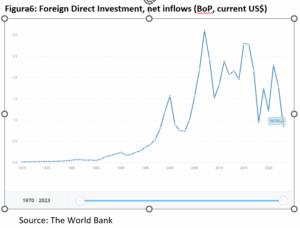
As Fig. 5 illustrates, FDI rose from a modest US$10 billion in 1970 to over US$2.3 trillion in 2021, peaking at US$3 trillion before the global crisis in 2007. This surge has been particularly notable since the 1980s, with a marked acceleration throughout the 1990s.
Fig. 5
Foreign Direct Investment, net inflows (BoP, current US$). Source: The World Bank
For three or four decades after the Second World War, foreign trade was the primary driver of globalization. A major shift occurred from the 1980s onward, when globalization became closely tied to FDI.
The evolving landscape of global competition can be summarized by the transformation of multinational companies from multidomestic to truly global firms (Porter, 1986). Competition no longer occurs on a country-by-country basis but has become genuinely global. Firms have moved away from managing international operations as a portfolio of subsidiaries acting like domestic firms (multidomestic) and instead now integrate these activities across borders.
One consequence of this transformation is the functional integration of geographically dispersed activities within multinational companies (Sachwald, 1994), which has significant implications for the economic relevance of domestic markets in countries where these companies operate.
We can illustrate this point with the case of the automobile industry, a key sector in Brazilian manufacturing, and the intense globalization process it has undergone since the 1990s. The industry has experienced significant changes—such as the rise of global cars, reduction in the number of platforms, global sourcing, and a hierarchical organization of suppliers—which have had a profound impact on the Brazilian auto parts industry (Costa & Queiroz, 2000).
In addition to increasing demands for product quality, technology, and complexity, Brazilian auto parts companies needed to become global suppliers. Respected firms such as Metal Leve, Cofap, and Freios Varga, although large and competitive by Brazil’s standards, became miniscule compared to the increasingly internationalized industrial complex and were eventually acquired by foreign companies. The global nature of competition, cross-country interlinkages, and technological change have all deepened in the recent past (Canuto & Martins, 2024).
In short, globalization has highly compromised growth strategies based on the size of domestic markets. This scenario echoes the warning issued by Fajnzylber (1983) when comparing the industrialization experiences of Latin American countries with those of their Asian counterparts. While Latin American countries followed a strategy of indiscriminate, small-scale reproduction of industries already existent in advanced countries, typical of import-substitution processes, Asian countries adopted a strategy led by domestic players focused on the global market. This approach has proven much more effective. Not by chance, Brazil and South Korea stand as “two tales of a MIT”—with Brazil trapped while South Korea continues its climb up the income ladder to reach advanced-economy status (Canuto, 2020).
4.2 GVCs
GVCs, where intermediate goods and services are traded through fragmented and internationally dispersed production processes, are another key expression of globalization. These chains, closely linked to FDI, are largely controlled by Transnational Corporations (TNCs). According to UNCTAD (2013), 80% of global trade is conducted through GVCs coordinated by these companies.
GVCs have a direct economic impact on value added, employment and income. There is a strong correlation between participation in GVCs and GDP per capita growth rates. The 30 developing economies with the highest growth in GVC participation from 1990 to 2010 experienced a median GDP per capita growth rate of 3.3%, compared to just 0.7% for the bottom 30 (UNCTAD, 2013).
For very large, developed economies—such as Japan and the United States—the benefits of GVC participation are relatively small. However, this is not the case for Brazil. The country’s low participation in GVCs, with notable exceptions like the aeronautics industry, limits its economic growth potential.
This issue extends beyond Brazil to Latin America as a whole, with the exception of Mexico and Central America which are more integrated into GVCs through the “maquiladoras” (CEPAL, 2014). Figure 6, showing the share of foreign value added in exports as an indicator of GVC participation, places South America (14%) at a much lower level than the developing country average (25%) in terms of integration into these chains.
Fig. 6
Share of foreign value added in exports, by region, 2010. Source: UNCTAD (2013)
In recent years, the geopolitical dispute between the U.S. and China has intensified, with likely consequences for the architecture of global trade. However, even if a slowdown in the expansion of GVCs can be detected, there was no clear trend towards deglobalization up to 2020 (OECD, 2023). Considering the current turbulence in global trade, this may well change. Still one potential effect of future changes is industrial relocation—through nearshoring and reshoring—driven by the need to ensure greater security of supply chains. Although these trends are still in their early stages (Alfaro & Chor, 2023; Canuto et al., 2023), they could well expand in the near future and present a new opportunity for countries like Brazil to deepen its integration into the restructured GVCs that should emerge.
5 An additional explanation for innovation and economic stagnation
We can now begin to draw some conclusions regarding two related questions addressed in this paper: Why do Brazilian firms engage so weakly in innovation activities? Why does Brazil’s potential economic growth remain so low?
Representatives of industry associations in Brazil, such as the CNI (Confederação Nacional da Indústria), frequently align with developmentalist perspectives in attributing Brazil’s premature de-industrialization and sluggish economic growth to neoliberalism. A telling example is a recent statement by Rafael Lucchesi, a CNI director, during a panel at the Fifth National Conference on Science, Technology and Innovation held in BrasíliaFootnote1:
“If we take the last 80 years of Brazil and divide them into two 40-year blocks, in the first, Brazil industrialized and was the fastest-growing country in the world. It went from a rural and agrarian society to an industrial and urban society. In fact, let’s be a little honest, everything we know about Brazil, the cities, the wealth, the economic development, the middle class that we have and built, was created by this industrialization process. And in the last 40 years, when we decided to believe a lie that was repeated many times, that everything was wrong, that our model was wrong, we became the country that lost the most productive complexity. We are the biggest loser…
In a major strategic error, we managed to regress, become poorer, and lose prominence. That’s all we achieved by adopting this neoliberal package, it’s important to say this… because we are ideologically biased, because we followed John Williamson’s advice, which is commonly referred to as the Washington Consensus, and we regressed and fell behind. We missed the train of history. We have to make up for lost time. And we have to build an industrial policy agenda, very well coordinated by this government, which is creating a state plan.”
In fact, the complaint against those who criticize the import-substitution industrialization model as a whole is justified. It functioned effectively for nearly 50 years, beginning in the 1930s. The issue, however, is that due to rising public-sector indebtedness, the model became exhausted as a source of dynamism—even before the process of shifting labor from low-productivity to higher-productivity activities had been completed (Canuto, 2019, 2023). While export-oriented industrialization flourished during the era of hyper-globalization, Brazil remained heavily reliant on its domestic market. Despite its considerable size, this market gradually lost relative importance. The glaring exceptions have been Brazil’s modern, technology-intensive agriculture and aircraft industries, both of which are strongly export-oriented.
Perhaps the most detrimental legacy of the import-substitution strategy has been the inward-looking orientation of Brazil’s industrial sector. For decades, focusing on the domestic market was sufficient to secure sizable profits—at least until the end of the 2000s. Furthermore, competition from imports was limited, as tariffs and a range of other protective instruments shielded local producers (Canuto et al., 2015).
Unfortunately for Brazil, the lessons from Fajnzylber (1983) were never internalized. Not only did he highlight the superior export-oriented strategies of Asian countries, but he also drew a crucial distinction between what he termed frivolous protectionism—as practiced in Latin America—and learning-oriented protectionism—as seen in Asia. His assessment has proven accurate over the past four decades.
This raises a fundamental question: Why would firms take risks and invest in R&D under conditions of frivolous protectionism and limited competition? Why would they engage in innovation activities if survival and profitability do not depend on it?
Ten years ago, Pedro Passos—one of the founders of Natura, a successful cosmetics company, and at the time president of IEDI (Instituto de Estudos para o Desenvolvimento Industrial), an industry think tank—wroteFootnote2:
“Competing in foreign markets and importing goods and services help expand production scales, reduce costs, allow access to state-of-the-art inputs and capital goods and, perhaps most importantly, increase competition, which in turn stimulates investment in innovation and the search for greater quality and productivity”.
This serves as a reminder that Brazil does have a small but influential group of industry representatives advocating for change in the current economic model. In addition to the agriculture sector—which, by targeting global markets, has managed to scale up, adopt new technologies, and become internationally competitive—a select group of industrial companies also stands out. These firms do not suffer from inward-looking bias and have established a significant presence in foreign markets. Natura is one such example, but we could also cite Embraer, Weg, Suzano, and a few others that have learned not to depend solely on the domestic market.
What does the experience of these exceptions in the industrial sector teach us? Primarily, that this small group of companies shows a strong commitment to R&D and innovation, even if their levels of R&D expenditure still fall short of those observed among global market leaders. The picture portrayed in the second section of this paper regarding Brazil’s innovation failure would look quite different if such cases were the rule rather than the exception.
The inward-looking bias also acts as a barrier to entry into GVCs and helps explain Brazil’s limited participation in them, as discussed in section four. Countries that adopted industrialization strategies less dependent on domestic markets found more effective paths into GVCs. The exceptional case of Embraer illustrates how this works. A key strategy employed by the company is engaging a large number of partners in the development and manufacturing of its regional and military aircraft. By securing a relevant position in the value chain—particularly in the design and final assembly of aircraft—Embraer developed the capability to identify and effectively coordinate numerous external partners and suppliers of parts and components, borrowing externally generated knowledge and assimilating it internally. To reach a leadership position in the regional jet market, expand its presence in executive aviation, and achieve successful forays into military aviation, the company accumulated technological and managerial capabilities essential to its global competitiveness. None of this would have been possible without its early orientation toward the international aviation market.
Similar traits can also be observed in Petrobras—the Brazilian mixed-capital oil company—particularly during periods when it was not constrained by politically driven “buy local” mandates or investment decisions (Canuto & Nakani, 2020).
In conclusion, the relationships between R&D expenditure and innovation, between technological change and productivity growth, and between increased productivity and economic growth are well established. Consequently, the low levels of business R&D investment, slow productivity growth, and weak economic performance seen in Brazil are interconnected phenomena. To break this vicious circle and escape the trap of growing too slowly to move up the per-capita income ladder, the country must overcome its inward-looking bias. It is not sufficient for companies to simply increase R&D expenditure; it is equally necessary to strengthen their learning and innovation capabilities.
6 Setting the agenda in accordance with a changing world
To overcome the barriers to innovation and economic growth in Brazil, it is essential to consider not only domestic but also external factors. Moreover, promoting innovation requires addressing both the supply and demand side. On the supply side, this includes ensuring the availability of physical and human capital, building institutions that facilitate innovation, and implementing subsidy schemes, fiscal incentives, and targeted government programs. Equally important on the demand side is to foster an economic environment—especially a competitive regime—that compels firms to innovate.
Let us begin by revisiting the two changes in the international landscape discussed in Sect. 4 and examining their implications for a renewed agenda to accelerate innovation.
6.1 Globalization and GVCs: what do they mean for innovation in Brazil?
The slowdown of the Brazilian economy in the 1980s had several circumstantial causes. Macroeconomic imbalances that had been building since the late 1970s began to exact their toll. In 1980, Delfim Netto, then Minister of the Economy, attempted to address these challenges by boosting economic activity—a move that led to a surge in inflation and further deterioration of the balance of payments.
This situation was exacerbated by the U.S. Federal Reserve’s sharp interest rate hikes to combat domestic inflation. Since most of Latin America’s (and South Korea’s) external debt was contracted at floating interest rates, the Fed’s policy shift quickly undermined debt solvency across the region.
Mexico’s default on its external debt in August 1982 triggered a global crisis that affected all highly indebted countries, including Brazil. It took until 1994 for Brazil to control inflation through the Plano Real and until the 2000s to reach a stable balance of payments position.
More structurally, as discussed earlier, globalization in the 1980s fundamentally altered the environment in which the Brazilian economy operated, drastically reducing the relevance of the domestic market. A potential response to this new context could have been to replace frivolous protectionism with a greater openness to trade. Indeed, President Collor de Mello—Brazil’s first democratically elected leader after the military regime—attempted to move in that direction. In a widely remembered speech, he likened domestically produced cars to “wagons,” urging the automobile industry to become more competitive and align with international standards.
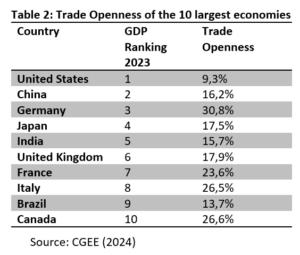
The limited trade openness seen in the following years did not change the fact that Brazil remained one of the most closed economies among the world’s ten largest—second only to the U.S., whose economy is many times larger than that of Brazil, as shown in Table 2.
Table 2 Trade Openness of the 10 largest economies. Source: The World Bank
In recent years, new developments have begun to challenge globalization. The geopolitical dispute between the U.S. and China is the most prominent of these, and the recent turbulence caused by the current U.S. administration is further evidence of this shift. In addition, the Covid-19 pandemic raised concerns about national security risks stemming from disruptions in global supply chains. A legitimate question, therefore, is whether it still makes sense to promote the internationalization of the economy in what some call a de-globalization scenario (Canuto, 2023b). Are the lessons from Fajnzylber (1983) still valid?
Our answer to this question is affirmative. Overcoming the inward-looking bias and adopting an “Asian” approach to development strategy—particularly for the manufacturing industry—remains relevant. However, this does not imply replicating the reforms that should have been implemented 40 years ago. A necessary adjustment is to take into account the concerns that are currently driving reshoring, nearshoring, and powershoring.
In fact, the ongoing changes in the global economy can create new opportunities for countries like Brazil. Advocating for powershoring, Arbache & La Rovere (2023) discuss the potential of green hydrogen production in Latin America and the Caribbean, particularly in Brazil. However, they emphasize the importance of developing the entire value chain associated with green hydrogen, including its application to the decarbonization of other segments of the domestic industry. The benefits, as they see them, are clear:
“The promotion of productive transformation provided by powershoring can contribute to the formation and consolidation of regional value chains, benefiting small and medium-sized companies, having substantial impacts on productivity and competitiveness, generating taxes, exports and foreign exchange, technology and innovation in Latin America and Caribbean”.
In this reconfiguration of the GVCs, influenced both by geopolitical changes and the imperative of decarbonization, a window of opportunity may be opening for Brazil to pursue deeper integration into the global economy. This is no simple task. To fully seize this opportunity, the country must address a number of challenges—including improving the business environment, implementing regulatory reforms, and investing in infrastructure—as previously discussed. Nonetheless, as the example of powershoring shows, participation in newly emerging value chains can yield significant rewards.
6.2 Some policy implications
As a corollary of the discussion above, several policy measures should be considered to help Brazil overcome its inward-looking bias:
Fight frivolous protectionism. For instance:
- Progressive reduction of import tariffs in line with the recommendation by Bacha (2013) to trade tariffs for more competitive exchange rates.
- Condition protectionist measures on the development of technological capabilities by the beneficiaries, with clearly defined goals for achieving international competitiveness within a certain timeframe. These measures must be temporary and subject to regular evaluation.
- The same principle should apply to local content requirements. It would be inappropriate, for example, to attempt to revive the Brazilian naval industry without identifying segments with real potential for international competitiveness and without establishing a clear timetable for the withdrawal of incentives (Alves et al., 2021).
Foster internationalization. For instance:
- Subsidy schemes and fiscal incentives should be tied to plans for increasing exports and/or promoting outward FDI. The focus on global markets must be sustained and long-term.
- All forms of international partnerships should be incentivized—from joint ventures between Brazilian and foreign companies to the attraction of international talent, such as scientists, engineers and skilled workers.
Focus on the entire value chain in selected industries where Brazil has already developed, or shows potential to develop, capabilities. For instance:
- Brazil’s global competitiveness in agriculture—the country has a leading position in agricultural goods, meat products, and beverages—creates favorable conditions to integrate into GVCs that supply manufactured goods and services to the sector.
- Similar opportunities exist in industries where Brazil has already made significant advances, such as aeronautics, pulp and paper, mining, pharmaceuticals, and cosmetics.
- The climate change agenda also presents strategic opportunities for Brazil, given its relatively clean energy matrix—provided it is paired with a “no deforestation” policy (Canuto, 2023b).
7 Conclusion
Several innovation-focused policies over time have failed to deliver the expected results in Brazil. An instructive comparison can be made between the evolution of industrial and technological policy and that of macroeconomic policy. After five unsuccessful attempts to control inflation during the late 1980s and early 1990s, the Plano Real finally succeeded in 1994. This success was the result of a learning process that led to improved diagnostics of the particular conditions that were producing inflation and consequently a better understanding of more effective measures to deal with it. Three decades later, however, no equivalent learning process has emerged to address Brazil’s premature de-industrialization, failed innovation strategies, and stagnant productivity and economic growth.
Evidently, the challenges are not directly comparable. Reaching political consensus to fight inflation proved to be much easier than forging agreement on a path forward for industrial policy. Aligning divergent interests and visions across sectors such as manufacturing and agriculture, and among the various actors in the innovation system, is more complex.
Nevertheless, the economic and political debate in the country continues to underestimate the extent to which global dynamics have changed—dynamics that no longer allow the country to perform as it once did. Advancing this debate requires acknowledging that globalization strongly penalizes growth strategies overly reliant on domestic markets. While recent shifts in globalization introduce new challenges, they do not herald a return to the inward-looking policies of the past.
If Brazil is to effectively promote innovation and accelerate economic growth, it must create a more competitive economic environment. This requires dismantling trade barriers and pursuing the internationalization of its firms. Frivolous protectionism merely sustains rent-seeking behavior by inefficient firms. Overcoming the inward-looking bias of Brazilian industry is a crucial step toward raising business R&D investment and promoting innovation. The successes cases like Embraer and the agriculture business show the way for the rest of the industry sector, show how important internationalization is. This conclusion is valid not only for Brazil but for other Latin American countries like Argentina or Colombia, as Fajnzylber (1983) well noted. In fact, emerging economies with development strategies not aiming to compete in global markets should all pay attention to the Brazilian case. The general lesson that can be drawn from this analysis is that competition is an important—and often neglected by policies—driver of innovation.
Pushing forward an agenda to increase competition in the Latin American economies is no easy task. Yet, it must be viewed as part of a broader and more urgent mission: breaking free from the MIT into which those countries have fallen.
To be clear, fostering competition alone is not sufficient to transform Brazil or its neighbors into innovation-driven economies. As discussed throughout this paper, several complementary conditions must also be in place. Assessing the role of each of these conditions is therefore a necessary complement to our discussion. Our goal herein has been to shed light on why the strategies that worked four decades ago are no longer effective today, and why industrial and innovation policies that fail to account for these structural shifts are unlikely to succeed.
Notes
- See https://horadopovo.com.br/pacote-neoliberal-que-assumimos-destruiu-nossa-industria-nos-ultimos-40-anos-denuncia-lucchesi/.
- See https://www1.folha.uol.com.br/fsp/mercado/189907-o-imperio-do-imobilismo.shtml.
References
- Acemoglu, D., & Robinson, J. A. (2013). Why nations fail: The origins of power, prosperity, and poverty. Crown Currency.
- Agénor, P-R., & Dinh, H. T. (2013). From imitation to innovation: public policy for industrial transformation. Economic Premise No. 115, World Bank, Washington DC.
- Agénor, P-R., & Canuto, O. (2015). Middle-income growth traps. Research in Economics, 69(4), 641–660.
- Agénor, P-R., & Canuto, O. (2017). Access to finance, product innovation and middle-income traps. Research in Economics, 71(2), 337–355.
- Aiyar, S., Duval, R., Puy, D., Wu, Y., and Zhang, L., Growth slowdowns and the middle-income trap, IMF Working Paper. No. 13/71. Washington, DC, 2013.
- Alfaro, L., & Chor, D. (2023). Global supply chains: The looming “great reallocation” (No. w31661). National Bureau of Economic Research.
- Alves, A. C., Vonortas, N. S., & Zawislak, P. (2021). A “Macro and micro foundations for technology upgrading and innovation: The case of shipbuilding and offshore industry in Brazil.” In J. D. Lee, K. Lee, D. Meissner, S. Radosevic, & N. S. Vonortas (Eds.), The challenges of technology and economic catch-up in emerging economies. Oxford: Oxford University Press.
- Arbache, J. & La Rovere, E. L. (2023). Transição Energética e Powershoring na América Latina e Caribe: Oportunidades, Desafios e Políticas Públicas, Banco de Desenvolvimento da América Latina e Caribe, Rio de Janeiro, December/2023.
- Bacha, E. (2013) Integrar para crescer. O Brasil na economia mundial, Estudos e Pesquisas nº 511, Fórum Nacional, Rio de Janeiro, 18–19 de setembro de.
- Canuto, O., Fleischhaker, C., & Schellekens, P. (2015). The curious case of Brazil’s closedness to trade. Policy Research Working Papers.
- Canuto, O., & Cavallari, M. (2017). Long-term finance and BNDES tapering in Brazil. OCP Policy Center.
- Canuto, O., & Ribeiro dos Santos, T. (2018). It’s evolution, baby–how institutions can improve without critical junctures. Policy Center for the New South, November, PB, 18, 39
- Canuto, O. (2019). Traps on the road to high income. Policy Center for the New South, Policy Brief PB-19/14, April.
- Canuto, O., & Nakane, M. I. (2020). Brazil at a post-pandemic macroeconomic crossroads (No. 2045). Policy Center for the New South.
- Canuto, O. (2020). Brazil, South Korea: Two tales of climbing an income ladder (No. 2005). Policy Center for the New South.
- Canuto, O. (2021). Climbing a high ladder-development in the global economy. Policy Center for the New South.
- Canuto, O., Arbouch, M., Zhang, P., & Ait Ali, A. (2023). GVCs, resilience, and efficiency considerations: Improving trade and industrial policy design and coordination (No. 2304). Policy Center for the New South.
- Canuto, O. (2023). The Amazon needs the rule of law, not the rule of chainsaw. Policy Center for the New South, March, 7.
- Canuto, O., & Martins, A. J. (2024). The automotive transition on the road to decarbonization (No. 2410). Policy Center for the New South.
- Canuto, O., Dinh, H. T., & El Aynaoui, K. (2024). The middle-income trap and resource-based growth: The case of Brazil. Rabat-Salé: Policy Center for the New South.
- Canuto, O., & Cavallari, M. (2020). Middle-income countries and multilateral development banks: Traps on the way to graduation. In J. A. Alonso & J. A. Ocampo (Eds.), Trapped in the middle? Developmental Challenges for Middle-Income Countries: Oxford University Press, Oxford.
- Canuto, O., Dutz, M., & Reis, J. G. (2010). Technological learning and innovation: Climbing a tall ladder. In O. Canuto & M. Giugale (Eds.), The day after tomorrow: A handbook on the future of economic policy in the developing world. Washington: World Bank.
- CEPAL—Integração regional: por uma estratégia de cadeias de valor inclusivas, 2014.
- Cirera, X., & Maloney, W. F. (2017). The innovation paradox: Developing-country capabilities and the unrealized promise of technological catch-up. World Bank Publications.
- Costa, I., & de Queiroz, S. R. R. (2000). Autopeças no Brasil: mudanças e competitividade na década de noventa. Revista de Administra&ccdeil; ão da Universidade de São Paulo, 35(3).
- Barbosa, F., Fernando, de H. & Pessôa, S. (2013) Educação e Desenvolvimento no Brasil, in Veloso, Fernando et al. (orgs.)–Desenvolvimento Econômico: uma perspectiva brasileira, Elsevier-Campus.
- Fajnzylber, F. (1983). La industrialización trunca de América Latina. Nueva Imagen.
- Gill, I. S., & Kharas, H. (2007). An East Asian renaissance: Ideas for economic growth. World Bank.
- Gonçalves, C. E. S. (2013) Desenvolvimento econômico: uma breve incursão teórica, inVeloso, Fernando et al. Desenvolvimento Econômico: uma perspectiva brasileira, Elsevier-Campus.
- Han, X., & Wei, S. J. (2017). Re-examining the middle-income trap hypothesis (MITH): What to reject and what to revive? Journal of International Money and Finance, 73, 41–61.
- IEDI (2010) Incentivos para a inovação: o que falta ao Brasil, Estudos “Desafios da Inovação“, fev/2010.
- Katz, J. (Ed.). (1987). Technology generation in Latin American manufacturing industries. MacMillan.
- Lall, S. (2019). Technological learning in the Third World: some implications of technology exports. In The economics of new technology in developing countries (pp. 157-179). Routledge.
- Lee, J. D., et al. (2021). Middle innovation trap: Capability transition failure and stalled economic growth. In J. D. Lee, et al. (Eds.), The challenges of technology and economic catch-up in emerging economies. Oxford University Press.
- Lee, J. D., Baek, C., & Yeon, J. I. (2021). Middle innovation trap: Capability transition failure and stalled economic growth. In J. D. Lee, K. Lee, D. Meissner, S. Radosevic, & N. S. Vonortas (Eds.), The challenges of technology and economic catch-up in emerging economies. Oxford University Press.
- Lee, K. (2013). Schumpeterian analysis of economic catch-up: Knowledge, path-creation, and the middle-income trap. Cambridge University Press.
- MCTIC—Indicadores Nacionais de CTI 2022.
- Mendes, M., org. (2022). Para não esquecer: Políticas públicas que empobrecem o Brasil. Insper.
- OECD “Deglobalisation? The Reorganisation of Global Value Chains in a Changing World”, OECD Trade Policy Paper, nº 272, April 2023.
- Pacheco, C. Américo & De N., Fernanda—Qual o rumo? Estadão, 10/12/2022, https://www.estadao.com.br/opiniao/espaco-aberto/qual-o-rumo/
- Porter, M. E. (1986). Competition in global industries: A conceptual framework. In M. E. Porter (Ed.), Competition in global industries. Boston: Harvard Business School Press.
- Queiroz, S. R. R.; Vonortas, N. S.; Canuto, O. (2025) “The challenge of fostering innovation and accelerating economic growth in Brazil”, Policy Center for the New South, Research Paper 03–25.
- Sachwald, F. (1994). Les défis de la mondialisation: Innovation et concurrence. Masson.
- UNCTAD (2013) World investment report 2013—global value chains: Investment and trade for development.
- Veloso, F., Feijó, J., Barbosa Filho, F. D. H., & Ruhe, A. P. (2024). Evolução do índice de capital humano anual para a economia brasileira: 1995–2022. Estudos Econômicos, 54(02), e53575423.