Policy Center for the New South, Policy Paper PP 12-26
Hajar Kabbach and Otaviano Canuto
I. Introduction: Why Care Matters for Morocco
Morocco stands at an economic crossroads. Despite two decades of sustained growth and improvements in human capital outcomes, labor market indicators have not kept pace. Unemployment remains high, particularly among youth and graduates, and is marked by a deep and persistent gender divide (HCP, 2025). Female labor force participation (FLFP) stands at just 19 percent—far below the global average of 50 percent and continues to decline despite an otherwise positive macroeconomic trajectory (Figure 1) (World Bank Gender Data Portal, 2026). This gap carries significant economic costs—estimates suggest that closing the gender employment gap could increase GDP per capita by 40 to 50 percent (World Bank, 2024b; Canuto & Kabbach, 2023).
While these outcomes are often attributed to demand-side constraints, such as limited job creation and unattractive working conditions, care responsibilities remain a critical and under-addressed barrier on the supply side.[1] Married women and mothers report caregiving and domestic responsibilities as the primary reason for staying out of the labor market. Moreover, Morocco has no public childcare system for children under the age of three and no formal eldercare infrastructure, despite a rapidly aging population.
Figure 1: Female Labor Force Participation: Morocco, Low- and Middle-Income Countries, and the Global Average
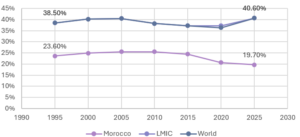
Source: Gender Data Portal, World Bank. Retrieved March 2026
The government of Morocco has recognized the urgency of increasing women’s economic participation. The 2021 New Development Model (NDM) sets a target of 45 percent FLFP by 2035, while the 2025 Jobs Roadmap prioritizes women’s economic inclusion through measures such as improving access to childcare and safe transportation (HCP, 2021; PCNS, 2025).
In parallel, the country has launched a large-scale social protection reform, including universal health coverage and direct income support, representing the most significant expansion of the state’s role in household welfare in decades. Morocco has also demonstrated its capacity to scale care-related infrastructure through its preschool expansion program, implemented through a public-private partnership model.[2]
Yet these efforts remain fragmented and are not embedded within a comprehensive care policy framework. The care economy remains largely informal and invisible, despite growing evidence that investments in care can generate substantial economic returns, including job creation, increased FLFP, and gains in productivity and fiscal revenues (UN Women & ILO, 2024).
This brief argues that investing in care is not merely a social expenditure, but a productive economic strategy with measurable returns. It brings together existing evidence and situates it within Morocco’s ongoing reform agenda to identify policy entry points that could help increase women’s economic participation.
II. Understanding the Care Economy
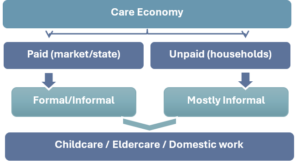
The care economy encompasses all activities—paid and unpaid—that sustain and reproduce human life across the life course. It includes direct services such as childcare, eldercare, and healthcare, as well as indirect activities such as cooking, cleaning, and household management that enable individuals to function and participate in society. These activities are delivered through a mix of formal markets, public services, civil society organizations, and unpaid labor within households (Figure 2) (ILO, 2025).
A defining feature of care is that a substantial share of it takes place outside formal markets, despite requiring time, skills, and resources with clear economic value. This creates a structural gap between the contribution of care and its recognition in economic statistics and policy frameworks. As a result, large segments of productive activity remain invisible, leading economies to systematically underestimate their own productive base (Folbre, 2014).
Figure 2: Components of the Care Economy
Measurement tools such as time-use surveys and satellite accounts help make this invisible work visible. By capturing how individuals allocate time across paid and unpaid activities, these tools provide critical insights into the distribution of care responsibilities and their implications for labor market participation and wellbeing. Valuation methods—such as the opportunity cost and replacement cost approaches[3]—further allow for the estimation of the economic value of unpaid care, reinforcing its significance within the broader economy.
Care systems are deeply gendered. Women perform the majority of unpaid care work globally, accounting for over 16 billion hours of daily labor devoted to caregiving and household maintenance. This unequal distribution translates into structural constraints in labor markets, limiting women’s access to employment, career progression, and income opportunities.
In 2023, 45 percent of women outside the labor force globally reported care responsibilities as the primary reason, compared to just 5 percent of men; in Northern Africa, this figure rises to 63 percent (see Figure 2) (ILO, 2024b). Morocco reflects this global pattern. According to UN Women, women and girls aged 15 and above spend, on average, 20.8 percent of their time on unpaid domestic and care work, compared to less than 3 percent for men (UN Women, n.d.).
Figure 3. Share of Men and Women Outside the Labor Force Due to Care Responsibilities By Region, 2023
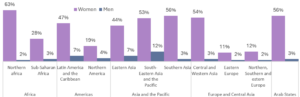
Source: ILO Brief, 2024, The Impact of Care Responsibilities on Women’s Labour Force Participation.
III. The Economic Case for Care Investment
The persistent framing of care as a social expenditure has long limited its integration into macroeconomic policy. However, a growing body of evidence shows that investment in care generates measurable economic returns—in employment, human capital development, and productivity—with multiplier effects comparable to, and in some cases exceeding, those of traditional infrastructure spending (ILO, 2025).
Care Investment Creates Jobs and Reduces Gender Gaps
Investing in care is one of the most effective strategies to expand employment, particularly for women. ILO projections across 82 economies estimate that closing gaps in childcare and long-term care could generate nearly 300 million jobs globally by 2035—96 million in childcare, 136 million in long-term care, and 67 million indirect jobs in non-care sectors. Of the total net employment created, 78 percent is expected to go to women, while 84 percent is expected to be in the formal sector (ILO, 2025). Investment policies that target care industries have been found to improve overall employment outcomes, reduce gender gaps, and increase male employment in equal measure, making care a broadly productive strategy rather than a narrowly redistributive one (International Trade Union Confederation, 2016).
Evidence from country-level studies reinforces the labor market case. Across OECD countries, a 10 percent increase in childcare availability is associated with a 3 percent increase in female labor force participation, with stronger effects in countries where formal childcare is both affordable and perceived as educationally beneficial (Koch, 2024). In Mexico, expanding early childhood education services has been shown to increase women’s economic participation while significantly reducing time poverty for employed women (Masterson et al., 2022). Beyond participation, childcare investment also has the potential to narrow the “motherhood employment gap”—the persistent earnings difference between mothers and non-mothers—and to support women’s progression into leadership roles (ILO, 2023).
Care Investment Builds Human Capital
The returns to care investment extend well beyond the immediate labor market. Quality early childhood care and education programs improve cognitive and socio-emotional development, school readiness, and long-term educational and health outcomes, with the largest gains accruing to children from lower-income households (Devercelli & Beaton-Day, 2020; Koch, 2024). In Brazil, a lottery-based allocation of public daycare found that children who gained access showed improved nutritional outcomes—height and weight for age—as well as enhanced cognitive development (World Bank, 2025a). In Chile, a universal program integrating health, education, and parental care components yielded positive effects on grade point averages and standardized test scores in mathematics and reading (Rude, 2024). For Morocco, where disparities in early childhood development outcomes between rural and urban areas remain significant, these human capital gains are particularly relevant.
Care Investment Can Be Self-Financing
A recurring concern in care economy policy discussions is fiscal sustainability—specifically, whether governments can justify allocating public resources to care in contexts of constrained budgets. The evidence suggests that this framing understates the returns. Care investments expand the productive base of the economy by increasing labor market participation and raising the share of formal employment, both of which generate additional tax and social contribution revenues (Seth, 2025). A study comparing early childhood care and pre-school education (ECCPE) investment with construction sector spending found that ECCPE performs better on short-run fiscal sustainability: 85.4 percent of new ECCPE positions are formal and socially insured, compared to just 30.2 percent in construction (Ilkkaracan et al., 2015). This finding, drawn from the Turkish economy, reflects a structural feature of care work that is broadly generalizable: the sector’s high formalization potential means that public investment in care can partially recover its own costs through expanded tax bases and social insurance contributions.
IV. Care Policy Packages – Lessons for Morocco
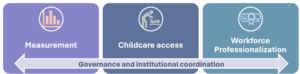
International experience shows that effective care policies are not standalone interventions but integrated and sequenced reform packages. Countries such as Uruguay, Mexico, Costa Rica, Colombia, and India illustrate that the gains from care investment depend not only on the choice of instrument, but on how instruments are combined, ordered, and institutionally embedded. Their experiences point to four key lessons for Morocco, structured around three operational pillars—measurement, access, and workforce development—and a cross-cutting governance and social norms framework (Figure 4).
Figure 4: Key Pillars for Care Economy Reform in Morocco
A. Establishing the Measurement Infrastructure for Care Policy
Sound care policy requires a robust evidence base. Without reliable data on how care is distributed and valued, policymakers cannot effectively target interventions, monitor progress, or build a credible fiscal case for investment. Morocco’s current data infrastructure remains limited. Only two national time-use surveys have been conducted (in 1997 and 2012), and no satellite account exists to capture the economic value of unpaid care work.
Uruguay offers a model of how data can drive policy. A 2007 national time-use survey revealed that women devoted two-thirds of their total working time—paid and unpaid combined—to unpaid care and domestic work, compared to one-third for men. The survey findings provided the empirical foundation for policy advocacy and contributed to the political momentum that culminated in Uruguay’s National Care System (Sistema Nacional de Cuidados), enacted in 2015. The system established statutory rights to care for children, the elderly, and people with disabilities; introduced quality standards and regulatory frameworks; and created a formal caregiving profession (United Nations Foundation, 2017; Garcia Mora et al., 2021). Uruguay’s experience illustrates a policy sequence in which investment in measurement preceded—and materially enabled—the establishment of a comprehensive care system.
Mexico extended this logic by developing an economic valuation framework. Since 2011, Mexico’s National Institute of Statistics and Geography (INEGI) has adopted the Satellite Account for Non-Remunerated Household Work (CSTNRH), a tool designed to translate the volume of unpaid care work into economic terms comparable to national accounts data. The satellite account estimated that non-remunerated household work represented approximately 23 percent of GDP in 2017, with women accounting for the large majority of this contribution. By expressing unpaid care as a share of national output, the satellite account repositioned care within macroeconomic policy discussions and provided a quantitative basis for advocacy by the National Institute for Women (INMUJERES) and other institutions (INEGI, n.d.; United Nations, 2017; UN Women, 2025). Mexico’s approach demonstrates that economic valuation of unpaid care can shift how the issue is framed in budget and planning processes.
Costa Rica took a more targeted approach, focusing on integrating care-related data into existing social registry infrastructure rather than developing a separate statistical instrument. In 2023, the government issued two decrees standardizing the measurement of functional dependency for adults and incorporating a dependency metric into the Sistema Nacional de Información y Registro Único de Beneficiarios del Estado (SINIRUBE), the country’s unified beneficiary registry for social programs. This measure enables the identification of households with functionally dependent members and provides the basis for targeting cash transfers to caregiving women in extreme poverty. The number of women receiving such transfers is projected to rise from 2,000 in 2023 to 6,000 by 2026, alongside an expansion of day services for the elderly and people with disabilities through the National Care System (SINCA) (United Nations, n.d.; World Bank, 2024a). Costa Rica’s experience illustrates how standardized measurement, when embedded in existing administrative systems, can support both targeting and redistribution.
For Morocco, these experiences suggest that strengthening the measurement infrastructure for care—through an updated time-use survey and the development of a satellite account methodology—would provide the empirical foundation needed to inform targeting, track progress, and integrate care into broader macroeconomic planning processes.
B. Expanding Childcare Access: Building on Existing Institutional Architecture
Morocco has a strong track record to build on. The preschool expansion program—a public-private partnership coordinated by the INDH and the Ministry of National Education, and delivered through national foundations working with local associations—has achieved substantial coverage gains: girls’ enrollment in preschool rose from 25% in 2017 to 93% in 2024, and over 9,500 preschool teaching positions were created, the majority in rural areas (World Bank, 2025). This track record demonstrates that Morocco can deploy a public-private partnership model at scale and with measurable results.
The remaining gap is concentrated in the 0–3 age group, for which no public provision currently exists, and there is no single model for filling this gap. Childcare provision takes multiple forms, and the appropriate modality varies by context, cost structure, quality profile, and coverage objective. Home-based, center-based, community-managed, and workplace-based arrangements each carry different trade-offs. Two country experiences illustrate approaches that are particularly relevant for Morocco.
Colombia’s Hogares Comunitarios de Bienestar (HCB) program provides home-based care to nearly two million children aged six months to five years. Community members provide care for groups of up to 15 children in home settings, under the oversight of nonprofit organizations operating under state contract, with financing drawn from public funds and parental fees capped at less than 25% of the daily national minimum wage. The program integrates nutrition, health, and early education components, and operates at significant scale, with over 65,000 registered home-based centers (Dina et al., 2025). Evaluations document improved cognitive and socio-emotional development among participating children, better nutritional outcomes, higher school retention among children aged 13 to 17 (by approximately 20 percentage points), and significant effects on maternal employment—including a 25 percentage-point increase in the likelihood of employment and approximately 75 additional working hours per month (World Bank, 2025a; Bernal & Fernández, 2013; Vera-Hernandez, 2004).
That said, home-based childcare arrangements are not without challenges: quality monitoring, provider training, and formalization of care workers are persistent issues in HBC models globally and require deliberate investment (Dina et al., 2025). Nevertheless, the HCB model demonstrates that a community-rooted, state-supported home-based program can achieve coverage at scale while generating measurable benefits for both children and mothers.
India’s Sangini Child Care Workers’ Cooperative, developed by the Self-Employed Women’s Association (SEWA) offers a structurally different approach organized around a cooperative governance model. The cooperative operates 13 childcare centers serving 350 to 400 children aged 0 to 6, of whom approximately one-third are under two years old. Centers are jointly owned by the care workers and the mothers whose children attend, creating a governance structure in which both groups have decision-making authority over service design and operation. Hours are calibrated to informal work schedules; fees are set at approximately 17% of running costs, with remaining expenses covered through cooperative revenues and SEWA’s broader institutional support (SEWA, n.d.; ILO & WIEGO, 2020). By formalizing care work through the cooperative structure, the model enables worker-owners to collectively negotiate wages, paid leave, and employment conditions, and provides access to social protection through SEWA’s associated cooperatives (ILO, 2024a). The model illustrates that cooperative governance can simultaneously expand care access, formalize care employment, and strengthen the economic position of care workers—although its replicability depends on the existence of a strong supporting institutional platform.
C. Professionalizing the Care Workforce
Expanding the supply of care services is necessary but not sufficient to improve outcomes. Service quality—which influences both child development results (in the case of childcare) and household decisions about whether to use formal care—depends substantially on the qualifications, working conditions, and professional status of care workers. At present, care occupations are among the lowest-paid and most precarious in the labor market. High turnover, limited training pathways, and the informal status of many care arrangements constrain the quality of services and limit the sector’s capacity to attract and retain qualified workers (World Bank, 2024c; International Trade Union Confederation, 2016).
Workforce development in the care sector involves two related challenges. The first concerns qualification pathways. Several countries have addressed this by creating flexible credentialing mechanisms that accommodate workers entering the sector from diverse educational backgrounds. Japan’s national qualification system for early childhood educators allows candidates to obtain certification through a specialized degree, through an unrelated degree combined with work experience, or through a qualifying examination—thereby broadening the recruitment pool without lowering entry standards. Quebec has introduced a work-study program that provides paid training to individuals already employed in early childhood education centers, enabling experienced workers to obtain formal credentials without leaving the workforce (World Bank, 2024c).
The second challenge concerns the formalization and labor protection of care workers in home-based and community-based arrangements. These modalities, which are most relevant for Morocco’s rural and peri-urban contexts, carry the highest risk of informality: care workers in these settings frequently operate without employment contracts, outside social security coverage, and without access to standard labor protections—patterns widely documented among home-based workers globally (ILO, 2015). Addressing this requires registration requirements for home-based providers, minimum wage provisions applicable to care work, and integration of care workers into Morocco’s expanded social protection framework.
D. Governance Coordination and Social Norms Change (Cross-Cutting)
Even the best-designed care policies can fail if they are not institutionally anchored or if social norms limit uptake. Both dimensions require deliberate attention in Morocco’s context.
On governance, responsibility for care-related policy in Morocco is currently distributed across the Ministry of National Education, Preschool and Sports, the Ministry of Economic Inclusion, Small Business, Employment and Skills, the National Agency for Social Support (ANSS), and the INDH, with limited coordination across these bodies. This fragmentation tends to produce gaps and complicates the pursuit of a coherent national care strategy with consistent standards and accountability mechanisms.
The country experiences examined in this brief each involved a formally mandated coordination architecture. Uruguay’s National Care Board (Junta Nacional de Cuidados)—chaired by the Ministry of Social Development and bringing together the Ministries of Economy and Finance, Education and Culture, Public Health, and Labor and Social Security, alongside the Social Security Bank and INAU (the national institute for children and adolescents)—provided the governance backbone of the National Care System, supported by a National Care Secretariat responsible for operational coordination and stakeholder engagement (United Nations Foundation, 2017; Garcia Mora et al., 2021). In Mexico, the National Care Systemis coordinated under INMUJERES, which had already built the institutional capacity to convene actors across health, education, and social development through the National Program for the Equality of Women and Men (INEGI, n.d.).
On social norms, in Morocco, cultural expectations surrounding women’s roles as primary caregivers constrain not only women’s labor market participation, but also the take-up of formal care services. Evidence from Egypt illustrates the scale of this barrier. Even when subsidized childcare was made available, uptake remained low due to normative resistance to nursery-based care over family-based care (Husseiny et al., 2025).
Rwanda’s gender-responsive community dialogue program (Indashyikirwa), which engaged both men and women in structured conversations about care responsibilities and gender roles, led to measurable shifts in attitudes and behaviors within two years of implementation, including improved collaboration between partners on household and care work (Dunkle et al., 2020).
For Morocco, integrating similar norm-change components into care programming—including campaigns that engage men and community leaders—is essential to ensuring that expanded services are effectively utilized.
Concluding Remarks
The evidence examined in this brief points to a consistent conclusion: the returns to care investment are not limited to social welfare outcomes, but extend to labor market participation, human capital development, and fiscal revenues. These returns are, however, contingent on how care policies are designed, sequenced, and institutionally embedded.
The three operational pillars—measurement, childcare access, and workforce professionalization—are mutually reinforcing. Measurement provides the empirical foundation for targeting and fiscal justification; childcare expansion addresses supply-side constraints on women’s employment; and workforce development sustains service quality over time. Governance coordination and shifts in social norms shape the environment within which these investments operate and determine whether supply-side gains translate into actual behavioral and economic outcomes.
Morocco’s ongoing reform agenda—including the NDM, the Jobs Roadmap, and the social protection reform—provides a policy context within which care-related investments can be institutionally anchored and scaled. Strengthening the measurement infrastructure and establishing a cross-ministerial coordination mechanism would represent two concrete steps toward building the evidence base and institutional capacity required for a more comprehensive care policy framework.
Bibliography
Bernal, R., & Fernández, C. (2013). Subsidized childcare and child development in Colombia: Effects of Hogares Comunitarios de Bienestar as a function of timing and length of exposure. Social Science & Medicine, 97, 241–249. https://doi.org/10.1016/j.socscimed.2012.10.029
Canuto, O., & Kabbach, H. (2023). Gender inequality in the labor market: The case of Morocco. Policy Center for the New South. https://www.policycenter.ma/sites/default/files/2023-03/PB_12-23_Canuto_Kabbach.pdf
Devercelli, A. E., & Beaton-Day, F. (2020). Better Jobs and Brighter Futures. World Bank, Washington, DC. https://doi.org/10.1596/35062
Dina, T. Q., Mbithi, A., & Ekobono, L. M. G. B. (2025). Guidance Note on Home-Based Childcare For Low-Income Communities. Washington, DC: World Bank. https://doi.org/10.1596/42882
Dunkle, K., Stern, E., Chatterji, S., & Heise, L. (2020). Effective prevention of intimate partner violence through couples training: A randomised controlled trial of Indashyikirwa in Rwanda. BMJ Global Health, 5(12), e002439. https://doi.org/10.1136/bmjgh-2020-002439
Folbre, N. (2014). Who cares? A Feminist Critique of the Care Economy. https://www.rosalux.de/fileadmin/rls_uploads/pdfs/sonst_publikationen/folbre_whocares.pdf
Garcia Mora, M. E., Schwartz Orellana, S., & Freire, G. (2021). Disability Inclusion in Latin America and the Caribbean. World Bank, Washington, DC. https://doi.org/10.1596/36628
HCP. (2021). Le Nouveau Modèle de Développement libérer les énergies et restaurer la confiance pour accélérer la marche vers le progrès et la prospérité pour tous. https://www.hcp.ma/attachment/2327975/
HCP. (2025). Situation du marché du travail en 2025. https://www.hcp.ma/Situation-du-marche-du-travail-en-2025_a4248.html
Husseiny, N. A., Caria, S., Crépon, B., Krafft, C., El-Mashad, A., & Osama, Z. (2025). When childcare subsidies and employment services are not enough: How social norms shape women’s choices in Egypt. J-PAL. https://www.povertyactionlab.org/blog/8-27-25/when-childcare-subsidies-and-employment-services-are-not-enough-how-social-norms-shape
İLKKARACAN, İ., KIM, K., & KAYA, T. (2015). The Impact of Public Investment in Social Care Services on Employment, Gender Equality, and Poverty: The Turkish Case. İstanbul Technical University, Women’s Studies Center in Science, Engineering and Technology. https://www.levyinstitute.org/pubs/rpr_8_15.pdf
ILO. (2015). Home-based workers: Decent work and social protection through organization and empowerment, Experiences, good practices and lessons from home-based workers and their organizations.
ILO. (2023). The benefits of investing in transformative childcare policy packages towards gender equality and social justice.
ILO (Ed.). (2024a). Strengthening women’s cooperatives: The experience of SEWA Cooperative Federation. International Labour Organization.
ILO. (2024b). The impact of care responsibilities on women’s labour force participation. International Labour Organization. https://www.ilo.org/sites/default/files/2024-10/GEDI-STAT%20brief_formatted_28.10.24_final.pdf
ILO. (2025). Employment-intensive investments for advancing decent work in the care economy. International Labour Organization. https://www.ilo.org/sites/default/files/2025-07/EIIP%20and%20care%20guidance%20note%20EN_Final.pdf
ILO, & WIEGO. (2020). Extending childcare services to workers in the informal economy: Policy lessons from country experiences. https://www.ilo.org/sites/default/files/wcmsp5/groups/public/@dgreports/@gender/documents/genericdocument/wcms_737555.pdf
INEGI. (n.d.). Unpaid Household Work. Retrieved April 13, 2026, from https://www.inegi.org.mx/temas/tnrh/
International Institute for Sustainable Development. (2026). A Measure of Care: How countries strive to move beyond GDP and capture the value of invisible work. International Institute for Sustainable Development. https://www.iisd.org/system/files/2026-03/measure-of-care-economy-beyond-gdp.pdf
International Trade Union Confederation. (2016). Investing in the care economy: A gender analysis of employment stimulus in seven OECD countries. International Trade Union Confederation. https://www.ituc-csi.org/IMG/pdf/care_economy_en.pdf
Koch, B. (2024). Exploring Child Daycare Affordability and Availability Amid Economic Shifts, Demographic Challenges, and the Role of Education in Shaping Future Generations. Unpublished. https://doi.org/10.13140/RG.2.2.29383.30882
Masterson, T., Antonopoulos, R., Pires, L. N., Rios-Avila, F., & Zacharias, A. (2022). Assessing the impact of childcare expansion in Mexico: Time use, employment and poverty. United Nations Research Institute for Social Development (UNRISD), Geneva. https://www.econstor.eu/bitstream/10419/273856/1/181597947X.pdf
PCNS. (2025). FEUILLE DE ROUTE POUR L’EMPLOI Optimiser l’opérationnalisation pour une relance inclusive et durable. https://www.policycenter.ma/sites/default/files/2025-03/PP_08-25%28Aomar%20Ibourk%20%26%20Tayeb%20Ghazi%29.pdf
Rude, B. (2024). Middle-run educational impacts of comprehensive early childhood interventions: Evidence from a pioneer program in Chile. Journal of Population Economics, 37(2), 38. https://doi.org/10.1007/s00148-024-01011-0
Seth, A. (2025). Engendering Fiscal Space: A Policy Framework for Financing Gender Equality. UN Women. https://www.unwomen.org/sites/default/files/2025-04/engendering-fiscal-space-a-policy-framework-for-financing-gender-equality-en.pdf
SEWA. (n.d.). About Us – Self Employed Women’s Association. Retrieved April 17, 2026, from https://www.sewa.org/about-us/
UN Women. (n.d.). Country Fact Sheet | UN Women Data Hub. Retrieved April 1, 2026, from https://data.unwomen.org/country/morocco
UN Women. (2025, June 30). Let’s Talk About Care: Mexico at the Forefront. UN Women – Americas and the Caribbean. https://lac.unwomen.org/en/stories/noticia/2025/06/hablemos-de-cuidados-mexico-a-la-vanguardia
UN Women, & ILO. (2024). Consolidated Report: A Guide to Public Investmenrs in the Care Economy: Estimating Care Deficits, Investment Costs and Economic Returns. https://www.ilo.org/sites/default/files/2024-07/consolidated-report-a-guide-to-public-investments-in-the-care-economy-en.pdf?utm_source=chatgpt.com
United Nations. (n.d.). Comprehensive cooperation to Costa Rica´s National Information System and Unique Registry of Beneficiaries (SINIRUBE) | Department of Economic and Social Affairs. Retrieved April 16, 2026, from https://sdgs.un.org/partnerships/comprehensive-cooperation-costa-ricas-national-information-system-and-unique-registry
United Nations. (2017). Guide on Valuing Unpaid Household Service Work. the Economic Commission for Europe. https://unece.org/fileadmin/DAM/stats/publications/2018/ECECESSTAT20173.pdf
United Nations Foundation. (2017). Uruguay’s national care policy: A virtuous cycle in data, advocacy and policy. https://data2x.org/wp-content/uploads/2019/08/UruguayCaseStudy_OECDDCR2017.pdf
Vera-Hernandez, M. (2004). Medium- and long run effects of nutrition and child care: Evaluation of a community nursery programme in rural Colombia. The IFS. https://doi.org/10.1920/wp.ifs.2024.4354
World Bank. (2024a). Costa Rica Social Risk Management Development Policy Loan with a Deferred Drawdown Option. World Bank. https://documents1.worldbank.org/curated/en/099110424171038278/pdf/BOSIB-ce760202-d5f0-413f-8d92-c22644f7f135.pdf
World Bank. (2024b). Female and Labor Force Participation in Morocco: Constraints and Priority Actions—Policy Note. http://documents.worldbank.org/curated/en/099121223075524067/P1781961d5e6a20711946a1463ff6354358
World Bank. (2024c). The Care Economy in Indonesia: A Pathway for Women’s Economic Participation and Social Well-being. Washington, DC: World Bank. https://doi.org/10.1596/42038
World Bank. (2025). From Vision to Impact: Preschool Enrollment Soars in Morocco [World bank]. World Bank. https://www.worldbank.org/en/news/feature/2025/09/24/from-vision-to-impact-preschool-enrollment-soars-in-morocco
World Bank. (2025a). Rationale for Investing in Childcare. https://documents1.worldbank.org/curated/en/099072325105052777/pdf/P179421-77af5509-91d5-43b2-ba1a-51be3433f98d.pdf
World Bank. (2025b). World Bank supports Morocco’s Commitment to Advancing Social Safety Nets for Human Development. World Bank. https://www.worldbank.org/en/news/press-release/2025/06/19/world-bank-supports-morocco-s-commitment-to-advancing-social-safety-nets-for-human-development
World Bank Gender Data Portal. (2026). Morocco. World Bank Gender Data Portal. https://genderdata.worldbank.org/en/economies/morocco
Hajar Kabbach is an analyst at the World Bank Group working at the intersection of labor markets and gender inclusion, supporting the Poverty and Equity and Social Development Global Practices, with a focus on Morocco and the MENA region. She holds a Master’s degree in Economic Analysis and Public Policy from Mohammed VI Polytechnic University.
Otaviano Canuto is a former vice president and a former executive director at the World Bank, a former executive director at the International Monetary Fund, and a former vice president at the Inter-American Development Bank. He is also a former deputy minister for international affairs at Brazil’s Ministry of Finance and a former professor of economics at the University of São Paulo and the University of Campinas, Brazil. Currently, he is a senior fellow at the Policy Center for the New South, a nonresident senior fellow at Brookings Institution, and a professor affiliate at UM6P.
[1] Married women are particularly disadvantaged in the labor market. They are 35 percentage points less likely to participate in the labor force than unmarried women, and 23 percentage points less likely than divorced or widowed women. This participation penalty increases in the presence of pre-school children and elderly household members (World Bank, 2024b).
[2] In 2018, Morocco set a national goal of universal preschool access for children aged 4 to 5 by 2028, with a particular emphasis on reaching rural and disadvantaged communities. Since 2018, preschool enrollment has increased significantly, rising from 45 % to 80 % nationally, and from 33 % to 91 % in rural areas (World Bank, 2025b).
[3] The opportunity cost method estimates foregone earnings due to reduced labor market participation and the replacement cost method calculates what it would cost to substitute unpaid care with equivalent paid services (International Institute for Sustainable Development, 2026).